很
Character Story & Explanation
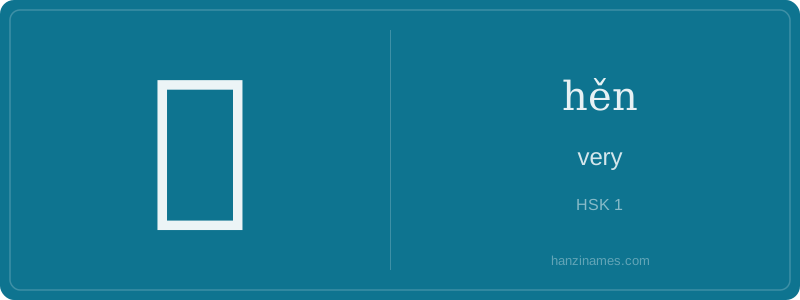
Historically documented in bronze inscriptions and early texts like the *Shuōwén Jiězì* (121 CE), 很 originally meant ‘difficult; stubborn’—a sense preserved in the classical idiom ‘很愎’ (hěn bì, 'obstinate and self-willed'). By the Tang and Song dynasties, its usage softened into a general intensifier, especially in vernacular literature such as *The Water Margin*. Today, it’s indispensable in daily speech: over 95% of HSK 1–2 adjective phrases use 很 (e.g., 很好, 很忙), and it appears more frequently than any other degree adverb in spoken Mandarin corpora.
The character is not pictographic—it has no oracle-bone or bronze form depicting an object. Its earliest attested form is seal script, combining 彳 (‘step’) and 艮 (phonetic). Modern learners encounter it first as a grammatical ‘glue’—not for vivid imagery, but for building natural-sounding sentences like ‘她很聪明’ (She’s very smart), where it carries no lexical weight yet makes the statement fluent and native-like.
As a linguistic detective, I begin with the character’s outer shell: the radical 彳 (chì), historically representing ‘footsteps’ or ‘to walk’—a common semantic component in characters related to movement, behavior, or conduct. Though 很 no longer conveys motion, this radical anchors it in the broader family of behavioral or relational terms, hinting at its grammatical role as a modifier of degree in human actions and states.
Inside the character lies the phonetic component 艮 (gèn), which once approximated the ancient pronunciation and still preserves a trace of its Old Chinese reading (*gənʔ). Unlike purely pictographic characters, 很 is a phono-semantic compound—its meaning evolved not from imagery but from syntactic function. By the Warring States period, texts like the *Zuo Zhuan* already used it to intensify adjectives, signaling a shift from concrete to abstract grammatical utility.
Crucially, 很 never meant ‘very’ in isolation in classical Chinese—it required context and often paired with adjectives or verbs to express relative degree. Its modern standalone use as a neutral intensifier (e.g., ‘I’m very happy’) is a grammatical innovation of late imperial and modern Mandarin, reflecting how syntax reshapes characters over centuries. This evolution mirrors Mandarin’s broader trend toward analytic structure—relying on function words rather than inflection.
Example Sentences
Common Compounds
Similar Characters — Don't Mix These Up
Your First Step into Chinese Culture: Get a Chinese Name
Every journey into Chinese begins with a name. Use our free Chinese name generator to create a meaningful, personalized Chinese name that fits you perfectly.
Get My Chinese Name →