怎
Character Story & Explanation
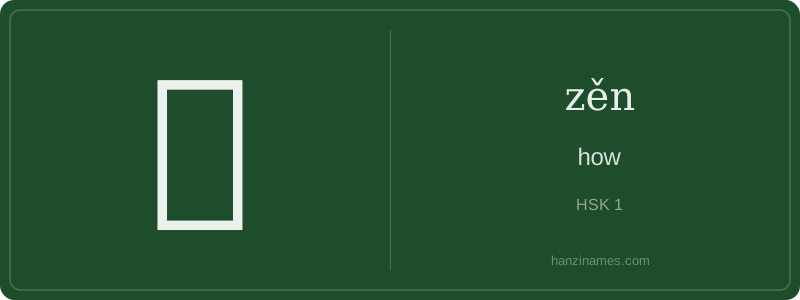
In modern Chinese daily life, 怎 almost exclusively appears in fixed interrogative compounds: 怎么 (zěnme), 怎样 (zěnyàng), and occasionally 怎生 (zěnshēng, literary). It’s absent from classical texts as a standalone word — instead, pre-Qin and Han texts used 何 (hé) or 安 (ān) for 'how'. The earliest documented use of 怎 as part of 怎么 appears in Yuan dynasty vernacular drama (e.g., *The Injustice to Dou E*), reflecting its rise with colloquial speech. Today, over 99% of 怎 usage occurs in 怎么 — the most frequent question word in spoken Mandarin (per COCA and BCC Corpus).
The character has no pictographic origin. It evolved from the late Han/Wei-Jin period phonetic-semantic compound: 乍 (zhà, 'suddenly') as phonetic component + 心 (xīn, 'heart') as semantic indicator — signaling that 'how' involves inner response or emotional stance. No oracle bone or bronze script forms exist; it’s a later linguistic innovation for conversational nuance.
Imagine you’re in a bustling Beijing hutong, clutching a paper map and squinting at a faded street sign. A kind elderly vendor from the nearby jianbing stall notices your confusion and smiles: 'Zěn me zǒu? (How do you go?)' — that single character 怎 instantly opens the door to help, direction, and human connection. It’s never used alone; always paired with 么 (me) or 样 (yàng), it forms the essential interrogative core of everyday Mandarin.
Visually, 怎 is elegant yet grounded: nine strokes flow from top to bottom, beginning with the ‘zhé’ (fold) stroke of the upper left component (乍), then descending into the heart radical 心 — literally placing 'how' in the realm of feeling, intention, and inner inquiry. This reflects Chinese linguistic philosophy: asking 'how' isn’t just about mechanics — it’s tied to mindset, care, and relational awareness.
As an HSK Level 1 character, 怎 appears early because it’s indispensable for basic communication — ordering food ('Zěn me diǎn?'), asking for directions ('Zěn me qù…?'), or expressing concern ('Zěn me le?'). Its frequency in spoken Mandarin surpasses many more complex characters, proving that profound utility often resides in simplicity — especially when rooted in the heart.
Example Sentences
Common Compounds
Similar Characters — Don't Mix These Up
Your First Step into Chinese Culture: Get a Chinese Name
Every journey into Chinese begins with a name. Use our free Chinese name generator to create a meaningful, personalized Chinese name that fits you perfectly.
Get My Chinese Name →