想
Character Story & Explanation
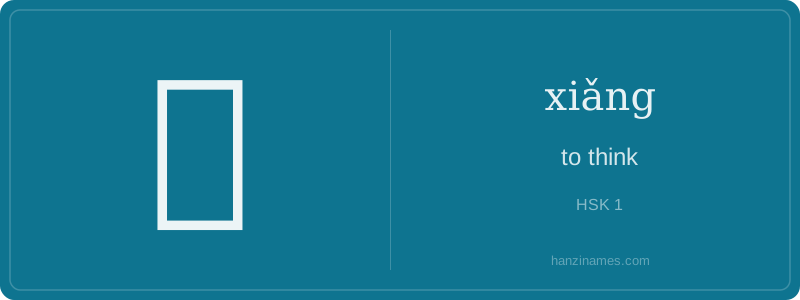
想 is foundational in modern Mandarin: it appears in HSK 1 vocabulary, used daily for expressing opinions (我想去), desires (我想吃), hypotheses (我想他来了), and memories (我想起来了). It features in the idiom 想入非非 (xiǎng rù fēi fēi)—‘to indulge in wild fantasies’—documented since the Ming dynasty. Historically, it was central to Neo-Confucian discourse on ‘investigating things to extend knowledge’ (格物致知), where 想 denoted disciplined reflection.
The character is not pictographic. Its upper part 相 evolved from a bronze script form depicting ‘eye observing wood’, meaning ‘to examine closely’. Combined with 心, it semantically compounds to ‘examine inwardly’—a documented phonosemantic construction (形声字) first attested in the Shuōwén Jiězì (121 CE), China’s earliest dictionary.
As an archaeologist brushing dust from a Han dynasty bamboo slip, I find 想 inscribed in clerical script—its 心 (heart) radical unmistakably centered, not as metaphor but as ancient physiological belief: thought resided in the heart-mind complex. The upper component 相 (xiāng, 'to observe mutually') suggests cognition as relational perception—not passive reception, but active engagement with the world. This reflects early Chinese epistemology: thinking is embodied, social, and sensory.
Excavations at Mawangdui revealed medical texts linking 心 to memory and intention, confirming 想’s core semantic field: deliberate mental activity—not just cognition, but desire, imagination, and anticipation. Unlike Western dualism, 想 never separates ‘thinking’ from ‘feeling’; its heart-radical signals that evaluation, longing, and reasoning arise from the same vital organ. Even today, native speakers say ‘I think’ (我想) and ‘I miss’ (我想你) with identical phrasing—revealing linguistic continuity over two millennia.
The character’s 13-stroke structure reveals historical layering: early seal script shows 相 atop 心, later standardized into today’s form. No oracle bone precursor exists—想 first appears in Warring States texts, emerging alongside philosophical debates on mind and intentionality. Its late appearance underscores how abstract cognition became linguistically codified only when Confucian and Daoist schools systematized inner life. Thus, 想 is less a universal ‘think’ and more a culturally specific technology of self-reflection.
Example Sentences
Common Compounds
Similar Characters — Don't Mix These Up
Your First Step into Chinese Culture: Get a Chinese Name
Every journey into Chinese begins with a name. Use our free Chinese name generator to create a meaningful, personalized Chinese name that fits you perfectly.
Get My Chinese Name →