吵
Character Story & Explanation
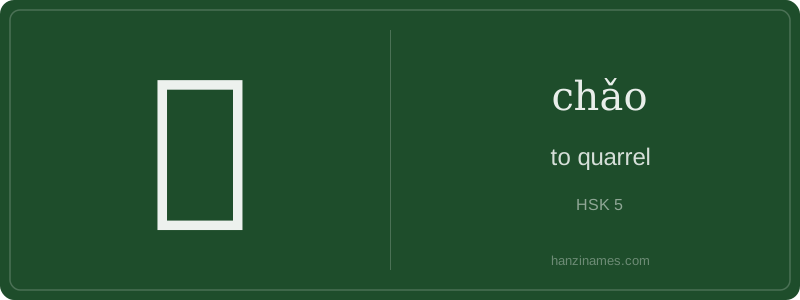
In daily life, 吵 most commonly appears in verbs like 吵架 (chǎo jià, 'to quarrel') and 吵闹 (chǎo nào, 'to make a racket'). It’s frequent in parenting contexts ('别吵!' — 'Stop shouting!'), neighborhood disputes, and workplace feedback ('会议室不能太吵' — 'The meeting room shouldn’t be too noisy'). The HSK 5-level usage reflects its role in nuanced interpersonal communication, not rudimentary vocabulary.
The character’s form is phonosemantic: 口 (kǒu, 'mouth') is the semantic radical, indicating speech-related meaning; 少 (shǎo, 'few, little') is the phonetic component, approximating the pronunciation chǎo in Middle Chinese. This structure—radical + phonetic—is standard for ~90% of modern Chinese characters and was systematized during the Han dynasty. No oracle-bone or bronze script forms survive for 吵; it first appeared in Song-era dictionaries as a colloquial character.
The character 吵 (chǎo) embodies a distinctly human tension in Chinese worldview: the mouth (口) as both vessel of harmony and source of discord. In Confucian-influenced society, speech is ethically charged—words must cultivate virtue, not inflame emotion. 吵 thus carries moral weight beyond noise; it signals a rupture in relational balance, where voices compete rather than resonate. Its simplicity (just seven strokes) belies its social gravity: a single raised voice can destabilize family, workplace, or community.
Unlike Western individualism that may valorize assertive expression, Chinese cultural grammar treats unmodulated speech as socially disruptive. 吵 reflects this sensitivity to sonic ethics—the idea that volume, tone, and timing matter as much as content. It appears not in formal edicts or classical poetry, but in everyday admonitions: ‘Don’t 吵!’ is a common parental rebuke, echoing the ideal of *he* (harmony) over *zheng* (contention). Even in modern urban life, ‘too 吵’ implies moral as well as auditory discomfort.
This character reveals how Chinese thought maps language onto relational ecology. The 口 radical isn’t neutral—it’s an active portal where inner emotion exits and affects others. When 吵 occurs, it’s not merely ‘arguing’ but failing in *ren* (benevolence) and *li* (ritual propriety). Thus, learning 吵 is not just vocabulary acquisition—it’s entering a cultural logic where silence is often wiser than speech, and harmony is maintained not by agreement, but by restraint.
Example Sentences
Common Compounds
Similar Characters — Don't Mix These Up
Your First Step into Chinese Culture: Get a Chinese Name
Every journey into Chinese begins with a name. Use our free Chinese name generator to create a meaningful, personalized Chinese name that fits you perfectly.
Get My Chinese Name →