吻
Character Story & Explanation
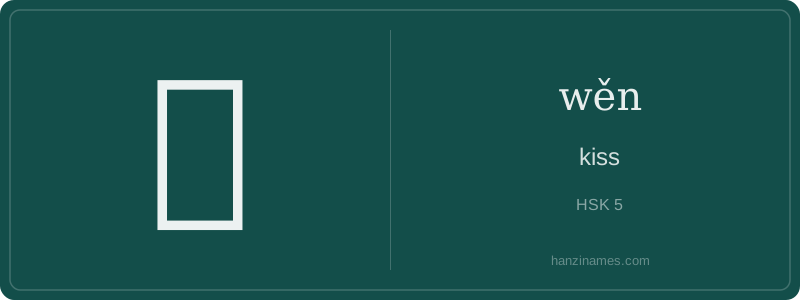
In modern Chinese, 吻 is primarily literary or formal — common in novels, poetry, news reports about romance or diplomacy, and medical contexts (e.g., 'kiss biopsy'). It rarely appears in casual speech, where 亲 (qīn) dominates ('Let’s kiss!' = 我们亲一下!). A well-documented phrase is 深吻 (shēn wěn, 'deep kiss'), used in health education and media. Historically, 吻 appears in Tang dynasty poetry describing parting gestures and Ming-Qing fiction portraying restrained intimacy — always implying solemnity or intensity.
The character has no pictographic origin; it’s a phono-semantic compound created during the Han–Wei transition. Its structure — 口 (mouth) + 務 (phonetic, originally pronounced *muts*) — reflects standard character formation logic, not visual imitation. Today, Chinese learners encounter it most often in HSK 5 reading passages about relationships, biology, or cross-cultural etiquette — never in elementary greetings or slang.
Our detective work begins with the radical 口 (kǒu) — 'mouth' — anchoring 吻 firmly in the realm of oral action. The right-hand component, 務 (wù), is a phonetic loan: though modern 務 means 'duty' or 'affair', its ancient form shared sound and shape roots with 吻, guiding pronunciation rather than meaning. This is classic phono-semantic compounding: mouth + sound clue = an action performed with the mouth.
Tracing through seal script (c. 221–206 BCE) and clerical script (Han dynasty), 吻 appears as a relatively late addition to the written lexicon — absent in oracle bone or bronze inscriptions. Its first verified appearances occur in early medieval texts like the *Shuōwén Jiězì* commentary tradition, where it’s explicitly defined as 'to press lips together' — confirming its semantic focus on intimate, intentional contact, not mere touching.
Unlike pictographic characters such as 日 (sun) or 山 (mountain), 吻 offers no visual mimicry of kissing. Instead, it reflects linguistic pragmatism: borrowing a familiar phonetic element (務) to create a precise term for a nuanced human behavior. Its seven-stroke simplicity belies its cultural weight — it entered HSK Level 5 not because it’s rare, but because it signals mature lexical control: distinguishing physical gesture (吻), emotional expression (亲), and literary metaphor (吻合) requires advanced semantic awareness.
Example Sentences
Common Compounds
Similar Characters — Don't Mix These Up
Your First Step into Chinese Culture: Get a Chinese Name
Every journey into Chinese begins with a name. Use our free Chinese name generator to create a meaningful, personalized Chinese name that fits you perfectly.
Get My Chinese Name →