咬
Character Story & Explanation
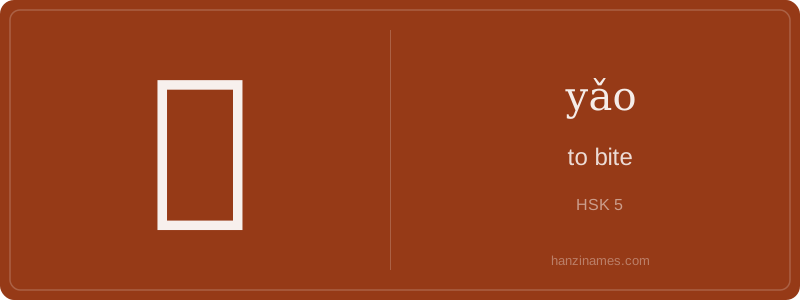
In daily life, 咬 is ubiquitous: parents warn children not to 咬铅笔 (bite pencils), dentists advise against 咬合不正 (malocclusion), and food lovers praise dumplings with perfectly 咬劲 (just-right chewiness). It appears in the idiom 咬紧牙关 (yǎo jǐn yá guān)—'clench one’s teeth'—a documented phrase since Ming dynasty texts, symbolizing perseverance under pressure. The term is also used metaphorically in finance: 'The loan interest is biting hard' → 利息咬得狠.
The character is not pictographic; its earliest attestation is in seal script (c. 3rd century BCE), where 口 (mouth) + 交 (interlocking shapes, later stylized) suggests the crossing of teeth—a phonosemantic compound. Modern learners most commonly encounter it in oral hygiene posters, school safety notices, and cooking shows emphasizing texture—making 'bite' a sensory anchor in Mandarin communication.
Imagine a summer afternoon in Chengdu’s People’s Park, where elderly locals play mahjong under bamboo shade. A toddler suddenly lets out a yelp—she’s just bitten her tongue while chasing a butterfly. Her grandmother gently says, 'Xiǎo xīn diǎn, bié yǎo zhe zìjǐ!' (Be careful—not to bite yourself!). Here, 咬 isn’t aggression—it’s an involuntary, physical action rooted in the body’s immediacy, signaled by the 口 (mouth) radical anchoring the character’s meaning in oral agency.
The character 咬 reflects how Chinese verbs often encode both action and intention. Unlike English ‘bite’, which can be neutral or hostile, 咬 carries contextual weight: it appears in warnings ('Don’t bite the hand that feeds you' → 别咬喂你吃饭的手), medical advice ('Don’t bite your nails' → 别咬指甲), and even digital slang ('She bit the comment' → 她咬了那条评论, meaning she replied sharply online). Its tone is sharp, percussive—like the sound of teeth closing.
At HSK Level 5, 咬 marks a shift from concrete actions to nuanced, idiomatic usage. Learners encounter it not just in zoology ('snakes bite' → 蛇咬人) but in figurative expressions like 咬文嚼字 (yǎo wén jiáo zì)—literally 'bite words, chew characters', meaning to nitpick over language. This compound reveals how 咬 extends beyond physiology into intellectual rigor, embodying a cultural value placed on precision—even in speech.
Example Sentences
Common Compounds
Similar Characters — Don't Mix These Up
Your First Step into Chinese Culture: Get a Chinese Name
Every journey into Chinese begins with a name. Use our free Chinese name generator to create a meaningful, personalized Chinese name that fits you perfectly.
Get My Chinese Name →