品
Character Story & Explanation
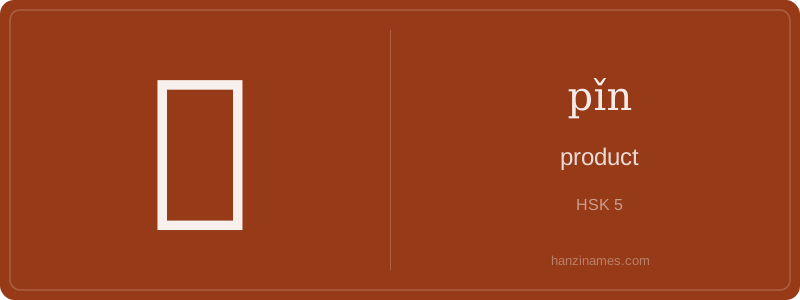
In everyday China, 品 appears on QR-coded product packaging in Shanghai supermarkets, in Taobao seller ratings ('好评率 99.8%', where 好评 means 'positive review'), and on factory inspection reports stamped with '合格品' (hégépǐn, 'qualified product'). The term 商品 (shāngpǐn, 'commodity') dates back to the Han Dynasty's state-run markets, while 品牌 (pǐnpái, 'brand') surged post-1980s economic reforms as domestic manufacturers competed for consumer trust.
The character’s form—a triple 口—is documented in bronze inscriptions from the Western Zhou (c. 1046–771 BCE) as a stylized representation of tasting or sampling in ritual contexts. Though not a literal pictograph of 'goods,' its repetition of 口 reflects the act of repeated verbal appraisal—'speaking about quality'—a practice codified in early texts like the *Rites of Zhou* (Zhou Li), where officials assessed grain, textiles, and metalwork using standardized 'three-taste' protocols.
The character 品 (pǐn) is a visually striking three-mouth glyph—three 口 radicals stacked vertically—that originally evoked the idea of tasting, sampling, or appraising something repeatedly. In ancient Chinese, 'tasting' extended metaphorically to 'evaluating quality,' which became central to its meaning: not just physical goods, but anything subject to judgment—products, art, conduct, even moral character.
Today, 品 appears ubiquitously in commercial and institutional contexts: product labels (商品 shāngpǐn), quality certifications (品质 pǐnzhì), and consumer reviews (口碑 kǒubēi—literally 'mouth reputation'). Its tripartite structure reinforces notions of standardization, consistency, and layered assessment—echoing China’s long tradition of imperial examinations and artisanal craftsmanship where items were graded by official inspectors.
At HSK Level 5, 品 signals lexical maturity: learners encounter it in nuanced compound words rather than isolation. It rarely stands alone as a noun meaning 'item'—instead, it functions within tightly bound terms like 用品 (yòngpǐn, 'supplies') or 品牌 (pǐnpái, 'brand'). Mastery requires recognizing how 品 anchors concepts of value, classification, and cultural evaluation—not merely 'stuff,' but 'stuff deemed worthy of attention.'
Example Sentences
Common Compounds
Similar Characters — Don't Mix These Up
Your First Step into Chinese Culture: Get a Chinese Name
Every journey into Chinese begins with a name. Use our free Chinese name generator to create a meaningful, personalized Chinese name that fits you perfectly.
Get My Chinese Name →