哈
Character Story & Explanation
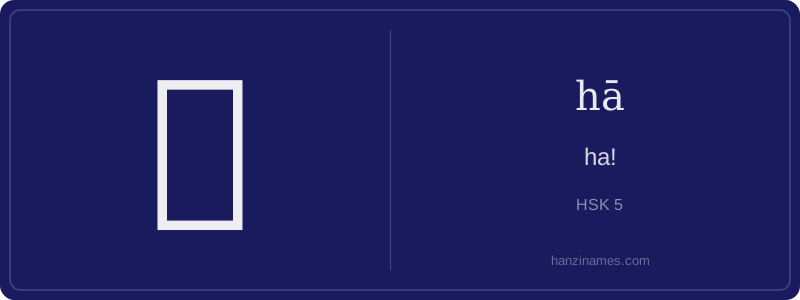
‘哈’ is overwhelmingly used today as an onomatopoeic interjection — documented in modern dictionaries (e.g., Xiandai Hanyu Cidian, 7th ed.) as an exclamatory particle expressing sudden amusement or mild incredulity. It frequently appears in colloquial speech, internet slang, and subtitles for animated reactions. A common phrase is ‘哈?’ (hā?) — equivalent to ‘Huh?!’ — widely attested in spoken corpora like the Beijing University Modern Chinese Corpus. It’s also part of fixed expressions like ‘哈欠’ (hāqiàn, ‘yawn’) and loanword adaptations (e.g., ‘哈佛’ Hāfó, ‘Harvard’).
The character is a phono-semantic compound: 口 (kǒu, ‘mouth’) is the semantic radical, indicating sound-related meaning; the phonetic component is 合 (hé), which historically provided approximate pronunciation. Though 合 is now pronounced differently, this reflects regular sound change — confirmed by Middle Chinese reconstructions (e.g., *qɒp* for 合, *qɑp* for 哈). No oracle bone or bronze script forms exist; it first appears in Han dynasty texts as a vocalization marker.
‘哈’ (hā) is one of Chinese’s most expressive interjections — a spontaneous, breathy exclamation that conveys amusement, surprise, or light-hearted disbelief. Unlike formal laughter like ‘哈哈’ (hā hā), the single ‘哈’ often appears mid-conversation as a conversational particle: a quick, almost involuntary ‘Ha?!’ — like catching your breath before reacting. It’s phonetically iconic: the open mouth radical 口 visually mirrors the physical act of exhaling laughter.
This character thrives in spoken and digital Mandarin. On WeChat or Douyin, users type ‘哈’ alone to signal dry wit or ironic acknowledgment — far more nuanced than a simple ‘lol’. Its tone matters: hā (first tone) is neutral or amused; hǎ (third tone) can mimic a choked laugh or mock disbelief (e.g., ‘哈?’ with rising-falling intonation). Native speakers instantly parse intent from tone and context — not dictionary definition.
While not a high-frequency lexical word, ‘哈’ punches above its weight in pragmatic communication. It softens criticism (‘哈,这方案有点难实施’), punctuates sarcasm (‘哈,您真会挑时间’), or even signals polite disengagement (a quiet ‘哈…’ while nodding). Its power lies in what it *withholds*: no full sentence needed — just that open-mouthed, human burst of sound captured in nine strokes.
Example Sentences
Common Compounds
Similar Characters — Don't Mix These Up
Your First Step into Chinese Culture: Get a Chinese Name
Every journey into Chinese begins with a name. Use our free Chinese name generator to create a meaningful, personalized Chinese name that fits you perfectly.
Get My Chinese Name →