唉
Character Story & Explanation
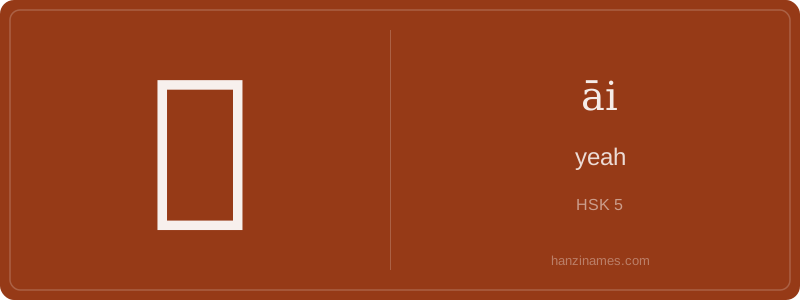
In everyday Chinese life, 唉 appears constantly in informal speech and digital communication — especially in WeChat voice notes, livestream comments, and online forums — to signal attentive listening without commitment. Linguistic corpora (e.g., the Beijing Language and Culture University Corpus) show it’s among the top 5 most frequent interjections in spontaneous Mandarin dialogue. It rarely appears in idioms, but occurs in fixed phrases like ‘唉声叹气’ (āi shēng tàn qì, ‘to sigh repeatedly’), listed in authoritative dictionaries like the Xiàndài Hànyǔ Cídiǎn.
The character 唉 is a phono-semantic compound: 口 (kǒu, ‘mouth’) is the semantic radical indicating vocalization, and 艾 (ài) is the phonetic component. Historically, 艾 was borrowed for its sound — not its meaning (‘mugwort’) — making 唉 a clear example of ‘phonetic loan’ usage documented since the Han dynasty. No pictographic origin exists; its form reflects systematic character formation principles, not ancient imagery.
‘Āi’ (唉) is a versatile interjection in Mandarin, most commonly expressing mild agreement, acknowledgment, or resignation — like a soft ‘uh-huh’ or ‘yeah, I see’ in English. It’s rarely written formally but appears frequently in dialogue-heavy contexts: novels, subtitles, social media comments, and spoken transcripts. Its tone is neutral to slightly weary, never sharp or angry — think of a teacher nodding as a student finishes an explanation, or a friend sighing softly while listening to a long story.
The character carries no lexical meaning on its own; it functions purely as a pragmatic particle. Unlike exclamations like ‘ā!’ (啊) or ‘ò!’ (哦), ‘āi’ often signals passive reception rather than surprise or excitement. Linguistically, it belongs to the category of ‘discourse particles’, helping regulate conversational flow. In HSK Level 5 materials, learners encounter it in authentic listening passages where speakers use it to maintain rapport without interrupting.
Though pronounced āi in standard Mandarin, the variant ài exists in some regional dialects and literary texts — notably in classical poetry or early 20th-century vernacular fiction — where it conveys deeper sorrow or lament. However, in modern Standard Mandarin, ài is rare and mostly archaic. For practical purposes, learners should master āi with the first tone and recognize its role as a subtle, culturally embedded vocal cue — not a word to define, but one to *feel* in context.
Example Sentences
Common Compounds
Similar Characters — Don't Mix These Up
Your First Step into Chinese Culture: Get a Chinese Name
Every journey into Chinese begins with a name. Use our free Chinese name generator to create a meaningful, personalized Chinese name that fits you perfectly.
Get My Chinese Name →