嘉
Character Story & Explanation
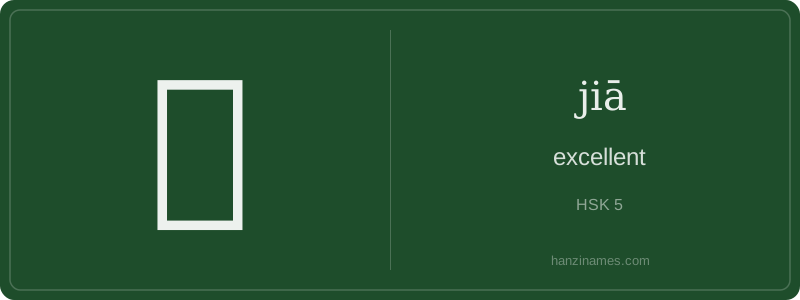
嘉 is widely used in official, ceremonial, and academic contexts across China. It appears in the national award ‘全国优秀教师嘉奖’ (National Commendation for Outstanding Teachers), in place names like Jiāyìng (a historic district in Guangdong), and in classical idioms such as ‘嘉言懿行’ (jiā yán yì xíng)—‘excellent words and virtuous deeds’, a phrase documented in the Song-dynasty text *Yunlüe*. It frequently modifies nouns like 德 (virtue), 奖 (award), or 宾 (guest), signaling formal commendation.
The character’s seal script form (c. 3rd c. BCE) shows 口 + 加, with 加 originally depicting a hand adding weight to a vessel—symbolizing enhancement. By Han dynasty texts like the *Shuōwén Jiězì*, 嘉 was explicitly defined as ‘beautiful, excellent; to praise’, confirming its semantic continuity for over two millennia. No oracle-bone form survives, but its structure reflects early conceptual linking of speech (口) and augmentation (加).
Imagine walking through the ancient stone lanes of Jiaxing in Zhejiang Province, where a local calligrapher demonstrates the character 嘉 on red rice paper during the Spring Festival. With steady brushstrokes, he explains that 嘉 doesn’t just mean ‘excellent’—it carries the weight of communal praise, like honoring a teacher’s dedication or celebrating a harvest. The radical 口 (mouth) hints at spoken approval, while the right side 加 (jiā, ‘to add’) suggests amplifying virtue through recognition.
This character embodies Confucian ideals of merit-based esteem: it appears in imperial examination records praising scholars and in modern school awards for ‘exemplary conduct’. Unlike generic synonyms like 好 (hǎo), 嘉 implies formal, earned excellence—something publicly affirmed, not casually observed. Its tone is warm but dignified, often reserved for moments of shared pride.
Even today, when a village elder receives a ‘Jiādé Jiǎng’ (Excellence in Virtue Award) from the local government, the certificate bears this character prominently. It’s not just linguistic—it’s cultural scaffolding: a visual reminder that excellence is relational, celebrated collectively, and rooted in moral action. That’s why learners at HSK 5 encounter 嘉 not as vocabulary, but as a value-laden lens into Chinese social ethics.
Example Sentences
Common Compounds
Similar Characters — Don't Mix These Up
Your First Step into Chinese Culture: Get a Chinese Name
Every journey into Chinese begins with a name. Use our free Chinese name generator to create a meaningful, personalized Chinese name that fits you perfectly.
Get My Chinese Name →