器
Character Story & Explanation
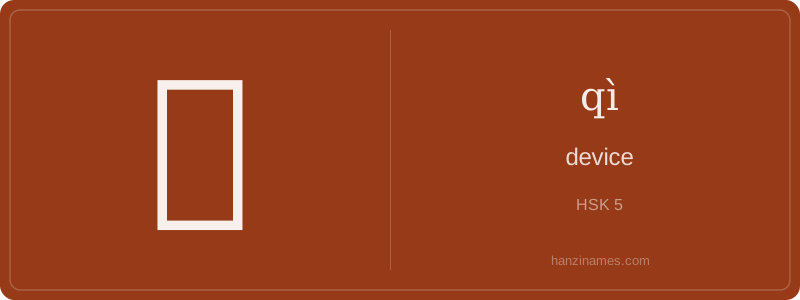
器 appears frequently in modern Chinese in compound words like 仪器 (yíqì, 'scientific instrument'), 器官 (qìguān, 'organ'), and 大器晚成 (dà qì wǎn chéng, an idiom from the *Dao De Jing* meaning 'a great vessel is completed late'—praising late-blooming excellence). It's standard in technical, medical, and philosophical contexts, and appears in the HSK 5 vocabulary list for its abstract yet precise usage.
The character’s form is not pictographic but phono-semantic: the four 口 radicals symbolize receptacles or openings (not literal mouths), while 犬 (quǎn, 'dog') serves as a phonetic component—though its sound has drifted over millennia. The earliest attested form (in bronze inscriptions, c. 11th–3rd century BCE) shows a vessel with handles and spouts—emphasizing containment and function, not animal imagery.
The character 器 (qì) embodies a profound Chinese worldview where tools, vessels, and instruments are never neutral objects—they carry moral weight, social function, and cosmic resonance. In classical thought, a 'device' is not merely mechanical; it reflects the user’s virtue, the maker’s intent, and the harmony of Heaven and Earth. This aligns with Confucian ideals: a ruler must be a 'vessel of virtue' (君子不器), meaning one who transcends narrow utility to embody adaptable wisdom.
Its four 'mouths' (口) framing a 'dog' (犬) in the center signal communal resonance—devices exist to serve, communicate, and sustain human relationships. Unlike Western notions of technology as dominion over nature, 器 implies responsible stewardship: a well-crafted vessel holds nourishment, truth, or ritual offerings—not just physical content, but cultural continuity.
Even today, calling someone a 'great vessel' (大器) conveys latent potential awaiting refinement—like bronze cast in a mold. This metaphor reveals how Chinese thought treats capability as relational, contextual, and ethically shaped. 器 thus bridges craftsmanship and character: to be useful is to be trustworthy, measured, and aligned with Daoist flow and Confucian duty.
Example Sentences
Common Compounds
Similar Characters — Don't Mix These Up
Your First Step into Chinese Culture: Get a Chinese Name
Every journey into Chinese begins with a name. Use our free Chinese name generator to create a meaningful, personalized Chinese name that fits you perfectly.
Get My Chinese Name →