嚏
Character Story & Explanation
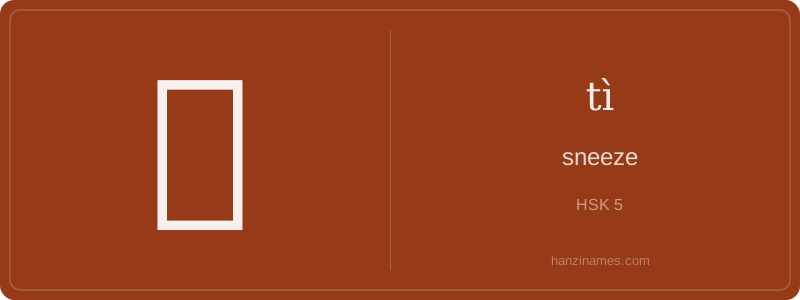
In modern Chinese, 嚏 appears almost exclusively in the compound 打喷嚏 (dǎ pēn tì, 'to sneeze'), a fixed, high-frequency phrase used in speech, health contexts, and literature. It rarely stands alone—unlike English 'sneeze', 嚏 is nearly always embedded in this verb phrase. Historical usage is sparse in classical texts; the earliest verifiable citations appear in Ming–Qing vernacular novels and medical manuals discussing wind-cold syndromes (e.g., Bencao Gangmu mentions sneezing as a diagnostic sign).
The character has no pictographic origin—it’s a phono-semantic compound created during the late imperial period. Instead of imagining ancient glyphs, picture this: a student in Beijing today writing 嚏 in HSK 5 practice, pausing at stroke #12 (the downward hook in 氒), then texting a friend: '我刚打了个嚏!'—only to delete it and type '打喷嚏' instead. That’s how it lives: real, functional, and stubbornly compound-bound.
Our detective begins at the crime scene: the character 嚏 (tì), meaning 'sneeze'. At first glance, it’s a mouth radical (口) paired with a complex right-hand component—no obvious pictorial sun or river here. Unlike ancient characters carved on oracle bones, 嚏 is a relatively late arrival, first reliably attested in medieval dictionaries like the Guangyun (1008 CE), where it appears as a phonosemantic compound—not drawn from nature, but engineered for sound and function.
The radical 口 confirms its domain: vocal, oral, involuntary bodily acts. The right side, 氒 (a variant of 弟, dì), serves primarily as a phonetic clue—though pronunciation has shifted from Middle Chinese *tʰeiH* to modern tì. This isn’t a fossilized pictograph; it’s linguistic forensics in action: a character built to signal both category (mouth-related action) and approximate sound, refined over centuries of scribal use and lexicographic standardization.
Crucially, 嚏 shows no evidence of oracle bone or bronze script origins—it’s absent from early inscriptions. Its emergence aligns with the codification of vernacular expressions in Tang–Song medical and colloquial texts. That makes it a linguistic artifact of daily life entering formal writing: not a royal decree or cosmic symbol, but the humble, universal, slightly embarrassing *achoo*. Its 17 strokes aren’t decorative—they’re the accumulated precision needed to distinguish it from homophones like 替 (tì, 'to replace') or 悌 (tì, 'filial respect'), proving that even sneezes demand orthographic care.
Example Sentences
Common Compounds
Similar Characters — Don't Mix These Up
Your First Step into Chinese Culture: Get a Chinese Name
Every journey into Chinese begins with a name. Use our free Chinese name generator to create a meaningful, personalized Chinese name that fits you perfectly.
Get My Chinese Name →