坦
Character Story & Explanation
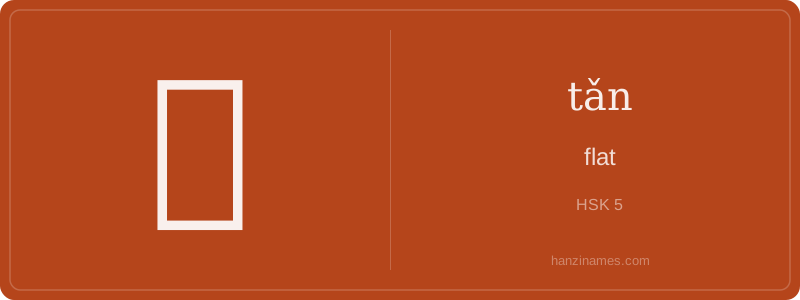
Today, 坦 is most commonly used in abstract, ethical contexts—not to describe literal flatness. It appears in HSK-5 vocabulary like 坦白 (tǎn bái, 'to confess'), 坦率 (tǎn shuài, 'frankness'), and 坦然 (tǎn rán, 'calm composure'). The idiom 坦荡荡 (tǎn dàng dàng), from Confucius’s *Analects* 7.37, describes a morally unobstructed person—'broad and level as open ground.' Government documents and news media frequently use 坦诚 (tǎn chéng, 'sincere') in diplomatic statements.
The character’s form has no pictographic origin—it’s a phono-semantic compound: 土 (tǔ, ‘earth’, semantic) + 旦 (dàn, simplified here to 又 in later script for phonetic approximation). The modern shape emerged from clerical script standardization; there is no oracle bone or bronze inscription of 坦—its earliest attestation is in seal script fragments from the Warring States period.
As an archaeologist brushing dust from a Han dynasty bamboo slip, I find 坦 inscribed in clerical script—not as a landscape feature, but as a moral topography. Its 土 (earth) radical anchors it in tangible reality, while the 又 (‘again’) component—once misread as ‘hand’—reflects phonetic borrowing from ancient *tʰan*, preserving pronunciation across millennia despite semantic drift from 'flat land' to 'unobstructed sincerity'.
This character’s stratigraphy reveals how Chinese writing fossilizes conceptual evolution. Early texts like the *Shuōwén Jiězì* (121 CE) define 坦 as ‘level ground,’ yet by the Tang dynasty, poets used it metaphorically: Du Fu wrote of a ‘坦怀’ (tǎn huái)—a ‘flat, uncluttered heart’—signaling emotional openness. The physical flatness of earth became the psychological openness of character.
Excavations at Mawangdui tombs confirm that 坦 appears in medical manuscripts describing ‘flat’ pulse patterns and in administrative records listing ‘坦途’ (tǎn tú)—‘level roads’—as infrastructure priorities. Its eight-stroke form stabilized during the Eastern Han, shedding earlier variant forms with extra dots or strokes. This standardization mirrors imperial efforts to unify measurement, language, and ethics—where flat terrain enabled both tax collection and moral clarity.
Example Sentences
Common Compounds
Similar Characters — Don't Mix These Up
Your First Step into Chinese Culture: Get a Chinese Name
Every journey into Chinese begins with a name. Use our free Chinese name generator to create a meaningful, personalized Chinese name that fits you perfectly.
Get My Chinese Name →