型
Character Story & Explanation
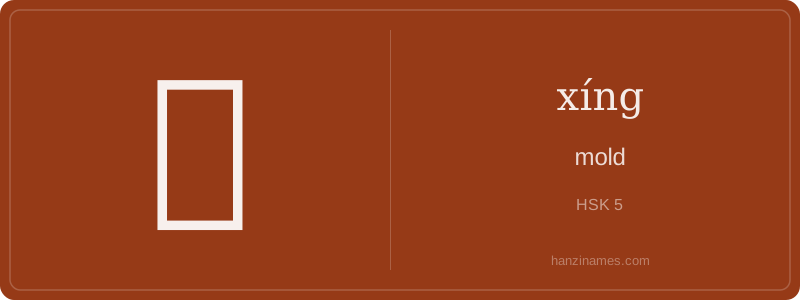
In modern Chinese, 型 is ubiquitous in technical, administrative, and everyday contexts: 'model' (e.g., 手机型号 'mobile phone model'), 'type' (e.g., 血型 'blood type'), and 'pattern' (e.g., 造型 'design/shape'). It appears in official terms like 标准型 ('standard model') and colloquial phrases like 新型 (xīn xíng, 'new type/model')—widely used in news headlines about pandemic variants or AI innovations. A documented idiom is 定型 (dìng xíng), meaning 'to finalize a form/structure', historically used in printing and engineering.
The character’s earliest attested form appears in seal script (c. 3rd century BCE), where it clearly combines 土 (earth/clay) and 刂 (knife/cutting tool)—reflecting its origin in mold-making. Unlike pictographic characters like 日 (sun), 型 is a semantic-phonetic compound (形声字): 土 signals meaning (earth-based craft), while 刑 (xíng, originally 'punishment' but here serving phonetically) provides sound. No oracle bone inscriptions of 型 survive; its documented history begins firmly in Warring States bronze inscriptions and Qin bamboo slips.
As an archaeologist brushing dust from a Han dynasty bronze casting mold fragment, I see 型 not as static ink—but as fossilized intention. Its 土 (earth) radical anchors it in the material world: ancient artisans pressed clay into earthen molds to replicate ritual vessels. The right side, 刂 (knife radical variant), hints at the carving and shaping required—precision that transformed raw earth into reproducible form. This character preserves the tactile memory of replication itself.
Over centuries, 型 evolved beyond metallurgy into abstraction. By the Tang dynasty, it appeared in administrative texts describing standardized tax forms and legal templates—proof that ‘mold’ had become synonymous with authoritative, repeatable structure. The character’s stability across 2,000 years reflects China’s deep cultural reverence for standardization: whether casting bells or drafting edicts, fidelity to the model was moral and practical necessity.
Today, 型 retains its dual nature: concrete and conceptual. It names physical objects like car models (车型) and abstract ones like personality types (性格类型). Its nine-stroke composition—beginning with the horizontal stroke of 土—mirrors the foundational role of the mold: first, the base; then, the defining contours. To write 型 is to reenact the ancient gesture of imprinting order onto chaos—a silent ritual preserved in every stroke.
Example Sentences
Common Compounds
Similar Characters — Don't Mix These Up
Your First Step into Chinese Culture: Get a Chinese Name
Every journey into Chinese begins with a name. Use our free Chinese name generator to create a meaningful, personalized Chinese name that fits you perfectly.
Get My Chinese Name →