尘
Character Story & Explanation
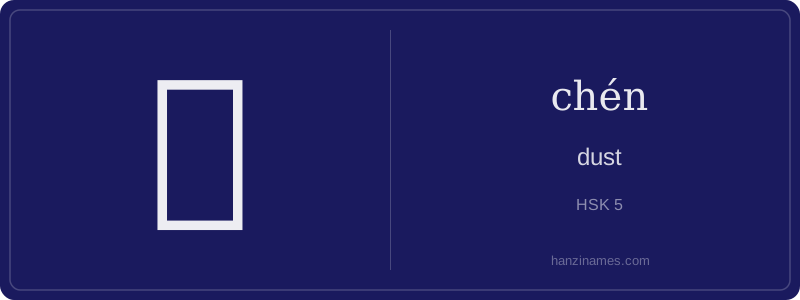
In daily life, 尘 appears ubiquitously: in public health warnings (防尘口罩, 'dust-proof masks'), classical idioms like ‘甚嚣尘上’ (shèn xiāo chén shàng, 'din and dust rising high'—meaning rampant rumors), and Buddhist texts where 'dust' symbolizes worldly delusion (e.g., 六尘, 'six dusts' representing sensory attachments). It’s also central to modern environmental discourse, especially in PM2.5 air quality reports widely broadcast across China.
The character is a clear phono-semantic compound: 小 (xiǎo, 'small') as semantic indicator (suggesting tiny particles) and 土 (tǔ, 'earth/soil') as phonetic component (though pronunciation diverged; 土 is tǔ, while 尘 is chén—reflecting Middle Chinese sound shifts). This structure has remained unchanged since the Qin standardization of script.
As an archaeologist brushing dust from a Han dynasty lacquer box, I found 尘 inscribed faintly on its inner rim—proof that this character was already in active use over two millennia ago. Its six-stroke form appears stable by the early clerical script (lìshū), showing no radical reshuffling: the 'small' (小) radical sits atop 'earth' (土), visually encoding the idea of minute particles settling on the ground. This structural clarity suggests intentional semantic design—not a later abstraction, but an early conceptual synthesis of scale and substance.
Excavations at Mawangdui revealed bamboo slips where 尘 appears in medical texts describing 'lung dust' (肺尘) — an astonishingly precise pre-modern recognition of occupational respiratory hazards. Unlike many characters whose meanings drifted over centuries, 尘 retained remarkable lexical continuity: from Warring States philosophical debates about 'dust obscuring the Dao' to Tang poetry lamenting 'dust of parting', its core referent—microscopic, airborne earth—remained anchor and metaphor alike.
What makes 尘 archaeologically compelling is its absence in oracle bone inscriptions—a telling gap. Its emergence coincides with urbanization: as cities like Chang’an grew, so did awareness of airborne particulates from traffic, construction, and incense. The character didn’t describe primordial chaos or mythic ash; it named a tangible, measurable environmental condition. That shift—from cosmological symbol to empirical descriptor—marks a pivotal moment in Chinese semiotic history: language catching up with lived, gritty reality.
Example Sentences
Common Compounds
Similar Characters — Don't Mix These Up
Your First Step into Chinese Culture: Get a Chinese Name
Every journey into Chinese begins with a name. Use our free Chinese name generator to create a meaningful, personalized Chinese name that fits you perfectly.
Get My Chinese Name →