壁
Character Story & Explanation
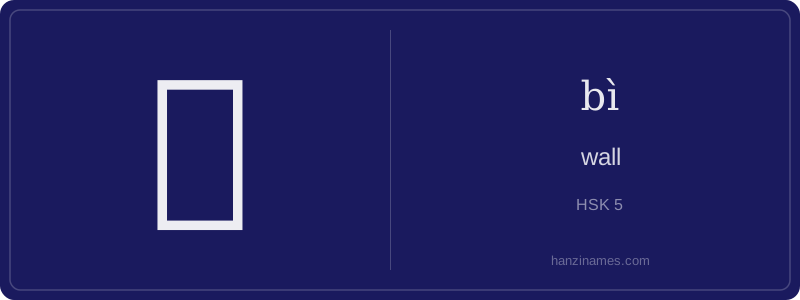
壁 appears frequently in modern Chinese in compound words like 屏幕 (píngmù, 'screen')—a digital 'wall' displaying information—and in idioms such as 铁壁铜墙 (tiě bì tóng qiáng, 'iron wall, bronze rampart'), denoting impregnable defense, widely used in historical narratives and military discourse since at least the Ming dynasty. It’s also common in real estate terms (如:承重壁, chéngzhòng bì, 'load-bearing wall').
壁 is a phono-semantic compound: the left 土 (earth) radical indicates material substance; the right 辟 (bì, originally meaning 'to open up' or 'to rule') serves as phonetic component. Though not a pictograph, its earliest attested form in seal script (c. 3rd century BCE) already shows this structure—confirming its long-standing association with constructed, earthen barriers.
The character 壁 (bì) embodies more than physical barrier—it reflects the Chinese worldview where boundaries are both protective and permeable. Walls in traditional architecture, like those of Beijing’s Forbidden City or courtyard homes (siheyuan), were never mere dividers but expressions of order, hierarchy, and harmony between human space and cosmic principles. The earth radical (土) grounds this concept in material reality and ancestral connection to land.
Historically, walls defined civilization itself—'within the wall' (墙内) signified cultural belonging, while 'beyond the wall' evoked the unknown or 'barbarian' realms. Yet paradoxically, walls also hosted vibrant cultural exchange: ink paintings adorned temple walls; poetry was inscribed on scholar’s studio walls; calligraphy scrolls hung on living room walls as moral anchors. Boundaries thus nurtured interior cultivation.
This duality—separation enabling reflection, enclosure fostering expression—reveals a core Confucian-Taoist tension: structure as a vessel for spirit. 壁 is not inert matter but a silent participant in daily ritual, literary imagination, and ethical life. Its presence reminds us that in Chinese thought, even architecture breathes intention—and every wall invites both shelter and contemplation.
Example Sentences
Common Compounds
Similar Characters — Don't Mix These Up
Your First Step into Chinese Culture: Get a Chinese Name
Every journey into Chinese begins with a name. Use our free Chinese name generator to create a meaningful, personalized Chinese name that fits you perfectly.
Get My Chinese Name →