壶
Character Story & Explanation
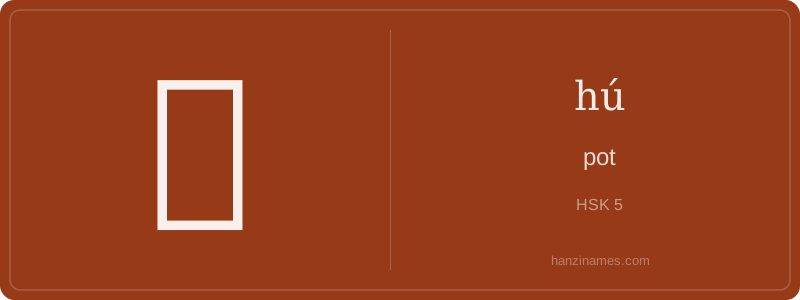
壶 is deeply embedded in Chinese material culture: archaeological records confirm bronze hu (壺) vessels were standard ritual wine containers during the Shang and Zhou dynasties (c. 1600–256 BCE), often inscribed with clan names. Today, it appears in everyday terms like 电水壶 (diàn shuǐ hú, electric kettle) and 保温壶 (bǎowēn hú, thermos), as well as idioms like ‘悬壶济世’ (xuán hú jì shì), meaning 'to hang up a pot to heal the world' — a classical metaphor for doctors practicing medicine, referencing ancient apothecaries who hung a gourd (later stylized as 壶) outside their clinics.
The character’s earliest verified form in bronze inscriptions resembles a stylized pot with a lid, wide body, narrow neck, and handles — not a pictograph of a person or abstract symbol. Its modern shape retains that essential silhouette, making it a rare example of a functional object preserved clearly across 3,000 years of script evolution.
Hi students! Let’s learn 壶 (hú), a Level 5 HSK character meaning 'pot' — specifically a container with a spout and handle, like a teapot or kettle. It’s not just any vessel: it’s designed for pouring liquids, especially in tea culture and daily cooking. Though it looks simple, its structure reflects ancient craftsmanship — the top part (士) isn’t actually the ‘scholar’ radical here; it’s a stylized lid or mouth of the pot, while the bottom (业) evolved from a pictographic representation of the body and base.
This character appears in many compound words related to containers, rituals, and even idioms. Unlike generic words for 'container' (like 容器 róngqì), 壶 carries cultural weight — think of Ming dynasty porcelain teapots or the bronze hu vessels from the Zhou dynasty used in ancestral ceremonies. Mastering 壶 helps you understand both practical vocabulary and historical context.
Don’t confuse it with similar-looking characters! Its 10-stroke form is compact but precise. The stroke order starts at the top-left: horizontal, then vertical, then the dot — followed by the lower ‘业’ component. Writing it slowly while visualizing a graceful teapot will help memory. And remember: in spoken Mandarin, hú is always first tone — clear and level, like holding a full pot steadily without spilling!
Example Sentences
Common Compounds
Similar Characters — Don't Mix These Up
Your First Step into Chinese Culture: Get a Chinese Name
Every journey into Chinese begins with a name. Use our free Chinese name generator to create a meaningful, personalized Chinese name that fits you perfectly.
Get My Chinese Name →