夜
Character Story & Explanation
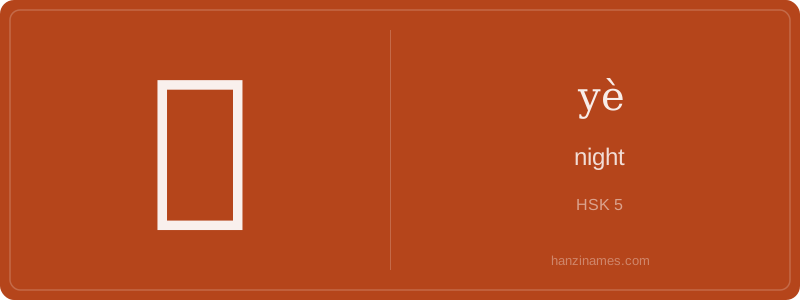
夜 is ubiquitous in modern Chinese life: used in weather forecasts ('tonight will be clear'), train schedules ('night train'), news headlines ('overnight developments'), and idioms like 夜以继日 (yè yǐ jì rì, 'day and night without pause') — a documented phrase since the Warring States period (475–221 BCE), appearing in the *Zuo Zhuan*. It also appears in classical poetry, such as Du Fu’s lines describing moonlit nights. In contemporary usage, '夜市' (yèshì, 'night market') is a beloved cultural institution across China and Taiwan.
The character 夜 evolved from seal script, where it combined 夕 (sunset) with a phonetic component 柰 (nài). While its earliest oracle bone form is not extant, bronze inscriptions (c. 1000 BCE) show 夕-based characters for evening/night. The modern form standardised in the 20th century retains 夕 as the semantic radical — a reliable visual cue that this character relates to dusk and darkness.
Hi students! Let’s explore 夜 (yè), meaning 'night'. It’s an 8-stroke character with the radical 夕 (xī), which itself means 'dusk' or 'evening' — a clue to its nighttime theme. Though it looks simple, 夜 isn’t just 'dark time'; in Chinese, it carries poetic weight — think quiet reflection, mystery, or even loneliness. You’ll see it often in literature, weather reports, and daily schedules. Don’t confuse it with day-related characters like 日 (rì, 'sun') or 早 (zǎo, 'early').
This character belongs to HSK Level 5, so it appears in more advanced vocabulary — not beginner dialogues like 'What’s the time?' but in expressions like 'midnight snack' or 'all-night study session'. Its pronunciation yè is a fourth-tone falling sound — practice saying it sharply, like a quick exhale: 'yeh!' (as in 'yes' but lower). Listen to native speakers emphasize the tone — mispronouncing it as yē (first tone) could mean 'liquid' (ye), so tone accuracy matters!
Writing 夜 carefully helps you remember it. Start with the 夕 radical on the left: two dots, then a curved stroke like a setting sun. Then add the right side — a simplified form of 柰 (nài), now written as 亠 + 丷 + 一 + 乚. But don’t memorize it as separate parts — instead, visualize 'the sun has set (夕), and night (夜) has arrived'. That mental image anchors both shape and meaning. Use grid paper to practice stroke order slowly — consistency builds muscle memory faster than speed.
Example Sentences
Common Compounds
Similar Characters — Don't Mix These Up
Your First Step into Chinese Culture: Get a Chinese Name
Every journey into Chinese begins with a name. Use our free Chinese name generator to create a meaningful, personalized Chinese name that fits you perfectly.
Get My Chinese Name →