夹
Character Story & Explanation
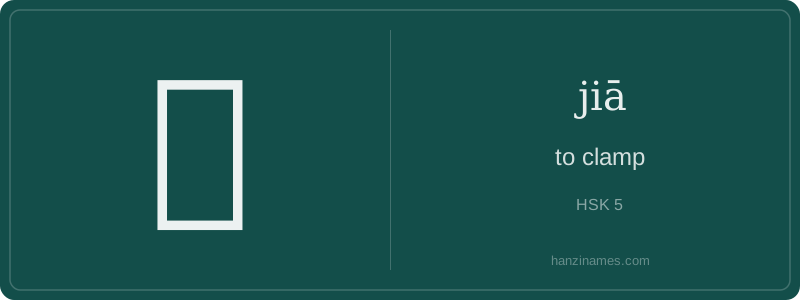
In daily life, 夹 appears ubiquitously: as a verb in ‘夹菜’ (jiā cài, ‘to serve oneself food with chopsticks’), a noun in ‘文件夹’ (wénjiànjiā, ‘folder’—literally ‘document clamp’), and in the HSK-5 idiom ‘夹枪带棒’ (jiā qiāng dài bàng, ‘speaking sarcastically, with veiled criticism’—originally evoking hidden weapons). Historically, the character first appeared in seal script (c. 3rd century BCE), where its structure already showed two outer strokes framing a central element—reflecting its core meaning of ‘pressing from both sides’.
The modern form (6 strokes) preserves this symmetrical framing: two horizontal lines (radical 一) at top and bottom, enclosing two diagonal strokes (丿 and ㇏) and a vertical stroke (丨)—visually representing convergence from left and right toward the center. No oracle-bone evidence survives, but its consistent structure across bronze and seal scripts confirms its early association with bilateral pressure.
The Chinese character 夹 (jiā) fundamentally conveys the physical and metaphorical idea of applying pressure from two opposing sides—like squeezing, pinching, or sandwiching. Unlike English verbs that often specify the agent (e.g., 'clamp', 'grip', 'sandwich'), 夹 is highly versatile: it functions as a verb, noun, and even a measure word. Its semantic core remains consistent across contexts—constriction, insertion, or containment between two surfaces—making it essential for describing everyday actions like holding paper with a clip or folding dumpling wrappers.
This dual-directional pressure concept resonates deeply in Chinese material culture and language logic. For instance, in culinary practice, jiaozi wrappers are ‘夹’ fillings before sealing; in engineering, a ‘夹具’ (jījù) is a vise that grips workpieces symmetrically. Western equivalents like 'clamp' or 'tongs' emphasize tool function, while 夹 emphasizes the *action* and *spatial relationship* itself—more abstract and process-oriented than most English counterparts.
Culturally, 夹 reflects a broader East Asian preference for relational, contextual meaning over isolated object definition. Where Western metaphors often rely on containment (‘in’, ‘inside’) or force (‘press’, ‘push’), 夹 uniquely encodes *bilateral constraint*. This appears in idioms like ‘夹在中间’ (jiā zài zhōngjiān)—‘stuck between two parties’—a vivid image of social tension mirroring physical compression. It’s not just about force, but about being positioned *between*, making it linguistically indispensable for expressing ambiguity, conflict, or layered identity.
Example Sentences
Common Compounds
Similar Characters — Don't Mix These Up
Your First Step into Chinese Culture: Get a Chinese Name
Every journey into Chinese begins with a name. Use our free Chinese name generator to create a meaningful, personalized Chinese name that fits you perfectly.
Get My Chinese Name →