奈
Character Story & Explanation
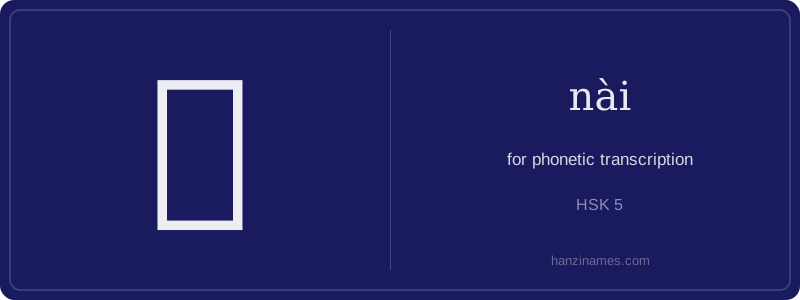
In daily life, 奈 appears almost exclusively in transliterated scientific, technical, and brand terms—never in idioms, poetry, or conversational grammar. It’s absent from all 2,500+ HSK 1–4 vocabulary items, appearing only at HSK 5 as a component of compound loans. Real-world usage includes 奈米 (nàimǐ, 'nano-') in Taiwan and Hong Kong (e.g., 奈米科技), and 奈特 (Nàitè) for 'Knight' in names. Historically, it appears in Ming-Qing Buddhist glossaries rendering Sanskrit 'nāga' as 奈伽—but always phonetically, never semantically.
The character’s form has no pictographic origin—it evolved from seal script variants of 大 + 女, likely as a simplified phonetic compound. No oracle bone or bronze inscriptions contain 奈. Today, Chinese speakers encounter it most often on product labels (e.g., '奈米涂层' — 'nano-coating') or academic syllabi, instantly recognizing it as a marker of foreign-derived terminology, not native meaning.
Our detective begins at the Han dynasty, where 奈 first appears in early lexicons—not as a meaning-carrying character, but as a phonetic loan. Its original use was purely syllabic: the sound 'nài' matched foreign terms entering Chinese via Silk Road trade and Buddhist sutras. Unlike semantic characters, 奈 offered no visual clue to meaning—its radical 大 (‘big’) is functionally inert here, a mere structural anchor inherited from its ancient form.
By the Tang and Song dynasties, 奈 became standardized in transliterating Sanskrit and later Persian words—like 奈落 (nàiluò) for ‘Naraka’ (Buddhist hell), or 奈氏 (Nàishì) for ‘Nasir’ in medieval texts. Crucially, it never developed native lexical meanings in classical usage; dictionaries like the *Kangxi Zidian* list only its phonetic role and rare archaic compounds, confirming its status as a linguistic placeholder.
Modern standardization cemented this function: the *Xiandai Hanyu Cidian* (7th ed.) defines 奈 solely by its sound value in transliteration, citing contemporary examples like 奈米 (nàimǐ) for ‘nano-’. Its eight-stroke structure—three horizontal strokes under 大, then 女—was fixed by the *Character Simplification Scheme* (1956), though the shape itself predates simplification. No semantic evolution occurred; it remains a phonetic tool, not a concept.
Example Sentences
Common Compounds
Similar Characters — Don't Mix These Up
Your First Step into Chinese Culture: Get a Chinese Name
Every journey into Chinese begins with a name. Use our free Chinese name generator to create a meaningful, personalized Chinese name that fits you perfectly.
Get My Chinese Name →