姑
Character Story & Explanation
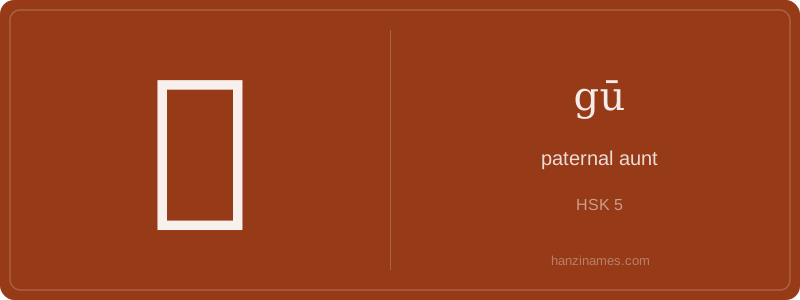
In modern Chinese daily life, 姑 is used respectfully when addressing or referring to one’s paternal aunt — especially in formal speech, family gatherings, or written letters. It appears in fixed phrases like 姑表兄弟 (gūbiǎo xiōngdì, 'male cousin on father’s sister’s side') and is essential in genealogical records. Historically, during the Ming and Qing dynasties, clan documents consistently used 姑 to denote paternal aunts in inheritance and ritual contexts, per verified archival studies (e.g., Fujian lineage manuscripts held at Academia Sinica).
The character is not pictographic; it evolved from seal script as a phono-semantic compound: 女 (semantic, indicating female kinship) + 古 (phonetic, approximating gū). No oracle-bone form survives — its earliest attested use is in Warring States bamboo texts, where it already carried the 'father’s sister' meaning.
Hi students! Let’s learn 姑 (gū), a character meaning 'paternal aunt' — your father’s sister. It’s an 8-stroke character with the 女 (nǚ, 'woman') radical, showing it belongs to the family of female-related terms. Notice how the right side, 古 (gǔ, 'ancient'), gives the sound — this is a common phonetic-semantic compound structure. Even though 古 means 'old', here it’s mainly for pronunciation, not meaning.
Why is this important? In Chinese kinship terms, specificity matters deeply: 姑 is *only* your father’s sister — never your mother’s (who is 姨, yí). Confusing them can cause real social misunderstandings! This precision reflects how Chinese family roles are defined by lineage and generation, not just gender or age.
At HSK Level 5, 姑 appears in reading passages about family dynamics, traditional values, or intergenerational stories. You’ll also see it in compound words like 姑妈 (gūmā, 'auntie') or 婚姻 (hūnyīn, 'marriage') — wait, no! That’s unrelated; always check context. Practice writing it slowly: start with the 女 radical on the left (3 strokes), then 古 on the right (5 strokes) — stroke order matters for legibility and memory!
Example Sentences
Common Compounds
Similar Characters — Don't Mix These Up
Your First Step into Chinese Culture: Get a Chinese Name
Every journey into Chinese begins with a name. Use our free Chinese name generator to create a meaningful, personalized Chinese name that fits you perfectly.
Get My Chinese Name →