委
Character Story & Explanation
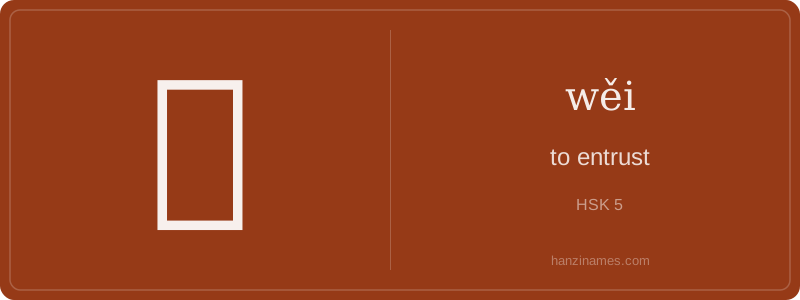
委 is widely used in formal and institutional contexts: government documents frequently employ 委任 (wěirèn, 'to appoint'), 委托 (wěituō, 'to entrust/commission'), and 委员 (wěiyuán, 'committee member'). The State Council’s official website lists hundreds of '委任通知' (appointment notices), and the term 委员会 (wěiyuánhuì, 'committee') appears in all major Chinese institutions — from the National People’s Congress Standing Committee to neighborhood residents’ committees. It also features in idioms like 委曲求全 (wěiqū qiú quán, 'to compromise to preserve unity'), where 委 carries the sense of 'bending' or 'yielding' — showing semantic extension beyond entrustment.
The character’s earliest attested form appears in bronze inscriptions of the Western Zhou dynasty (c. 1046–771 BCE), where 委 depicts a woman (女) bending at the waist — symbolizing submission, humility, or readiness to receive duty. Though its pictographic origin isn’t literal 'entrusting', the posture evolved semantically to signify accepting responsibility under authority — later reinforced by its use in bureaucratic terminology during the Qin and Han dynasties.
The Chinese character 委 (wěi) fundamentally conveys the idea of entrusting responsibility or authority to another person — a concept deeply embedded in Confucian-influenced social structures where hierarchy, duty, and relational trust are paramount. Unlike Western notions of delegation that often emphasize task efficiency or contractual obligation, 委 carries moral weight: it implies confidence in the recipient’s integrity, competence, and loyalty. This nuance appears in official appointments, family roles, and even literary metaphors.
Historically, 委 was used in classical texts like the *Zuo Zhuan* and *Analects* to describe rulers assigning duties to ministers — not as administrative convenience, but as an ethical act reinforcing mutual obligation. In modern usage, it retains this gravity: being ‘委以重任’ (entrusted with important duties) is a high honor, reflecting both capability and moral standing. This contrasts with English ‘assign’ or ‘delegate’, which rarely evoke such layered expectations.
In cross-cultural comparison, Western equivalents like ‘appoint’, ‘commission’, or ‘depute’ focus on legal authority or procedural legitimacy, whereas 委 emphasizes relational fidelity and contextual appropriateness. For example, one might ‘委派’ (wěipài) a colleague to represent the team — not just because they’re available, but because their character and judgment align with the mission’s values. This reflects China’s enduring preference for guānxi (relationship-based trust) over purely transactional delegation.
Example Sentences
Common Compounds
Similar Characters — Don't Mix These Up
Your First Step into Chinese Culture: Get a Chinese Name
Every journey into Chinese begins with a name. Use our free Chinese name generator to create a meaningful, personalized Chinese name that fits you perfectly.
Get My Chinese Name →