姥
Character Story & Explanation
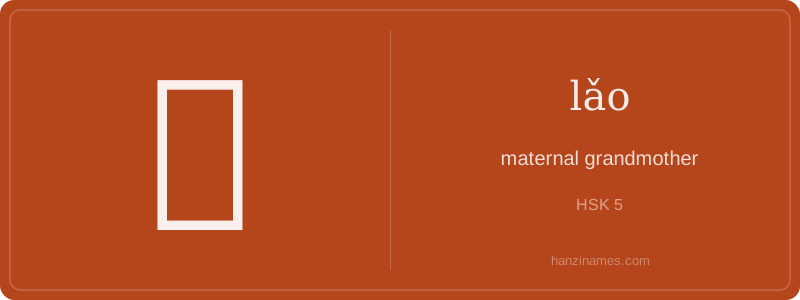
姥 is widely used in daily speech across northern and central China, especially in the affectionate reduplicated form 姥姥 (lǎo·lao). It appears in common phrases like 姥姥家 (lǎo·lao jiā, 'maternal grandmother’s home'), a frequent destination for children during summer breaks—a documented cultural pattern affirmed by China’s Ministry of Education family education surveys. The term also features in idioms like 姥爷姥姥都疼你 (lǎo yé lǎo lǎo dōu téng nǐ, 'both grandfathers and grandmothers dote on you'), highlighting intergenerational warmth.
The character’s structure combines the female radical 女 (nǚ) with an old phonetic component 老 (lǎo), indicating both semantic category (female elder) and pronunciation. While 老 originally meant 'old', its use here is phonetic—not conceptual—so 姥 is not a pictograph but a phono-semantic compound. No oracle-bone or bronze script forms exist for 姥; it first appeared in Song-dynasty dictionaries as a colloquial variant, later standardized in the 20th century.
The Chinese character 姥 (lǎo) primarily means 'maternal grandmother'—the mother’s mother—and reflects the deep-rooted Confucian emphasis on kinship hierarchy and maternal lineage. Unlike English, which uses a single term 'grandma' for both paternal and maternal grandmothers, Mandarin distinguishes them precisely: 姥姥 (lǎo·lao) for maternal grandma and 奶奶 (nǎi·nai) for paternal grandma. This linguistic precision mirrors social practices where maternal grandparents often play distinct caregiving or emotional support roles, especially in urban families with dual-income parents.
In spoken Mandarin, 姥姥 is commonly reduplicated for familiarity and affection, much like 'Granny' or 'Nana' in English—but with stricter grammatical and cultural boundaries. The alternate reading mǔ is archaic and appears only in classical texts or compound words like 姥母 (mǔmǔ), meaning 'grandmother' in formal or literary contexts. Modern usage overwhelmingly favors lǎo, especially in northern dialects and standard Putonghua.
Compared to Western equivalents, 'grandma' in English is broadly inclusive and often lacks lineage specificity, while terms like 'mater’nal granny' sound clinical and rare. In contrast, 姥 carries embedded relational clarity: it cannot refer to paternal relatives, nor can it be used without specifying the maternal line. This reflects China’s historical matrilineal recognition in kinship terminology—even within a patriarchal framework—where maternal grandparents held unique legal and ritual roles, such as officiating certain wedding rites or hosting children during school holidays.
Example Sentences
Common Compounds
Similar Characters — Don't Mix These Up
Your First Step into Chinese Culture: Get a Chinese Name
Every journey into Chinese begins with a name. Use our free Chinese name generator to create a meaningful, personalized Chinese name that fits you perfectly.
Get My Chinese Name →