姻
Character Story & Explanation
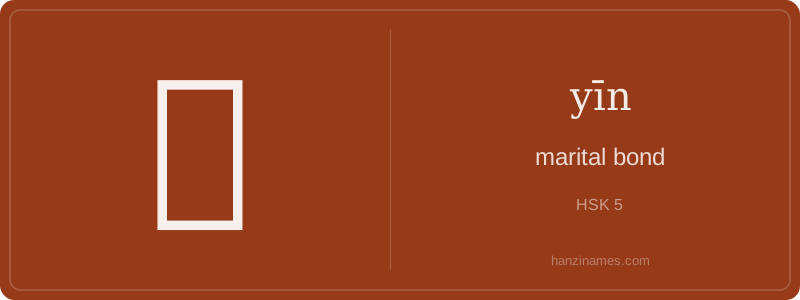
姻 is most commonly used in formal and literary contexts related to marriage networks — especially in compounds like 姻亲 (yīnqīn, 'in-laws'), 姻缘 (yīnyuán, 'marital fate'), and 婚姻 (hūnyīn, 'marriage'). It appears frequently in official discourse, legal texts, and family histories. A well-documented idiom is 三姑六婆 (sān gū liù pó), where 'six types of female relatives' includes 姻 (as in 姻婆, an older term for marriage broker). Modern media and government campaigns promoting 'harmonious families' also regularly feature 姻 in slogans and policy documents.
The character first appeared in seal script (c. 3rd century BCE) with the 女 radical on the left and 因 on the right — a clear phono-semantic compound. 因 was already a stable phonetic element by the Warring States period, and no pictographic origin is attested. Its structure has remained unchanged since Han dynasty standardization, reflecting its consistent semantic domain: marriage-as-relational-bond.
The character 姻 (yīn) embodies the Confucian understanding of marriage not as a private contract, but as a foundational social bond that interweaves families across generations. Its radical 女 (nǚ, 'woman') signals gendered roles in traditional kinship systems, while the phonetic component 因 (yīn) — meaning 'cause' or 'reason' — subtly conveys that marriage is both cause and consequence of familial continuity. In classical thought, 姻 reflects the idea that marital alliances are strategic, ethical, and cosmological acts, linking households to uphold harmony (hé) and ritual propriety (lǐ).
Unlike Western individualist notions of romantic love, 姻 emphasizes relational responsibility: the bride becomes part of her husband’s lineage, and the groom’s family assumes duties toward hers. This is visible in terms like 姻亲 (yīnqīn, 'marital relatives'), where kinship extends beyond blood to include in-laws as moral equals. The character thus encodes a worldview where personal identity is co-constituted through marriage-based obligations — a principle still echoed in modern wedding rituals and family expectations.
Even today, 姻 carries quiet weight in legal, social, and emotional contexts. China’s Marriage Law (1950, revised 2001) uses 姻 to define rights and responsibilities between spouses and their extended families. In rural communities, matchmakers (xiāngqīn rén) are sometimes called 姻缘牵线人 — 'threaders of marital fate'. The character appears in official documents, genealogies, and even divorce proceedings, reminding us that marriage in Chinese culture remains less about two individuals and more about the alignment — and ongoing negotiation — of two family systems.
Example Sentences
Common Compounds
Similar Characters — Don't Mix These Up
Your First Step into Chinese Culture: Get a Chinese Name
Every journey into Chinese begins with a name. Use our free Chinese name generator to create a meaningful, personalized Chinese name that fits you perfectly.
Get My Chinese Name →