昨
Character Story & Explanation
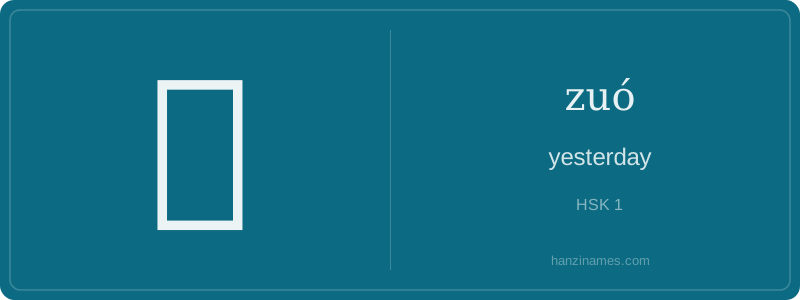
In modern Mandarin, 昨 appears almost exclusively in the compound 昨天 (zuótiān, 'yesterday'), used daily in speech and writing — from weather reports ('昨天很热') to personal stories ('昨天我见了老师'). It’s absent in classical texts as a standalone time marker; early Chinese used terms like 昔 (xī) for 'past'. No idioms feature 昨 alone — it’s functionally bound to 天. You’ll hear it constantly in news headlines, chat messages, and language exams.
The character is a semantic-phonetic compound: left side 日 (rì, 'sun/day') is the meaning indicator; right side 乍 (zhà) historically provided sound approximation (Middle Chinese *tsak > zuó). This structure is well-documented in Shuōwén Jiězì (121 CE), China’s first dictionary — confirming its role as a time-related phonosemantic character, not a pictograph.
Hi students! Let’s learn 昨 (zuó), which means 'yesterday' — a super common word you’ll use every day in Chinese. It’s an HSK Level 1 character, so it’s one of the first 150 essential characters you’ll master. Notice its radical is 日 (rì), meaning 'sun' or 'day' — that’s your memory anchor! This tells you the character relates to time, specifically a day in the past.
The right side is 乍 (zhà), which originally meant 'suddenly' but here serves mainly as a phonetic component (giving the 'zuó' sound). Don’t worry about memorizing 乍 yet — just focus on how 昨 looks and sounds as a whole. With only 9 strokes, it’s manageable to write once you practice the correct stroke order: start with the sun radical on the left, then add the right part step by step.
Unlike English, Chinese doesn’t change verb tenses — instead, time words like 昨 tell us *when* something happened. So if you say 我吃饭了 (wǒ chīfàn le), adding 昨 makes it 昨我吃饭了 — wait, no! Actually, we say 昨天我吃饭了 (zuótiān wǒ chīfàn le), because 昨 alone isn’t used without 天 (tiān, 'day'). That’s key: 昨 almost always appears in the compound 昨天. Think of 昨 as the 'yester-' root — like 'yesterday', 'yesteryear', but in Chinese, it’s bound to 天.
Example Sentences
Common Compounds
Similar Characters — Don't Mix These Up
Your First Step into Chinese Culture: Get a Chinese Name
Every journey into Chinese begins with a name. Use our free Chinese name generator to create a meaningful, personalized Chinese name that fits you perfectly.
Get My Chinese Name →