书
Character Story & Explanation
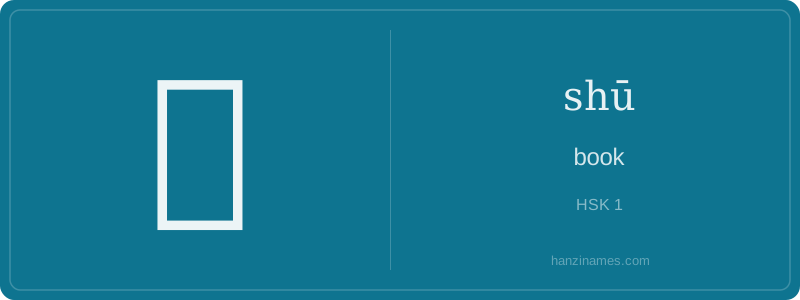
In daily life, 书 is ubiquitous: students carry shūbāo (书包, schoolbags full of books), libraries are called túshūguǎn (图书馆), and ‘reading a book’ is kàn shū (看书). It appears in the Confucian classic Shūjīng (书经, 'Book of Documents') and the idiom dú wàn juǎn shū (读万卷书, 'read ten thousand scrolls') — a centuries-old ideal of scholarly cultivation. Modern usage includes digital contexts: diànzǐ shū (电子书, e-book) and shūmíng (书名, book title).
The character’s form has no pictographic origin (unlike 日 or 木); it’s a stylized abbreviation of ancient 書. Its four strokes follow strict order: 一 (horizontal), 丨 (vertical), ㇇ (horizontal折 hook), 丶 (dot) — reflecting cursive simplification from Tang-Song dynasty clerical and running scripts, officially standardized in 1956’s Chinese Character Simplification Scheme.
As a linguistic detective, I begin with the modern form of 书 (shū): four clean strokes, deceptively simple. Its radical 丨 (gǔn) — a vertical line — is rare as a semantic component but here anchors the character’s structural spine. Though classified under 丨 in dictionaries, historically this radical reflects later clerical script regularization, not original meaning. The character’s minimal stroke count (4) makes it one of the earliest taught in HSK 1 — a foundational glyph for literacy.
Peeling back layers, I consult paleographic records: 书 evolved from the seal script character 書, which itself derived from the bronze script form featuring a hand holding a brush over a 'writing surface' (often interpreted as 'tablet' or 'strip'). The modern simplified 书 is a radical streamlining — dropping the 'hand' (扌) and 'tablet' (曰/日-like element), retaining only the essence: deliberate, linear inscription. No oracle bone form survives for 书; its earliest attested use appears in Warring States bamboo slips circa 4th century BCE.
This character doesn’t depict a physical book like a codex, but rather the *act* and *artifact* of writing itself — a conceptual leap from ‘to write’ to ‘that which is written’. In classical texts, 书 often meant ‘writings’, ‘documents’, or even ‘a classic’ (e.g., the Book of Documents, 尚书 Shàngshū). Its semantic range widened with printing: by the Song dynasty, 书 unambiguously meant bound books as we know them. Today, it’s the universal, neutral term for ‘book’ — secular, scholarly, and everyday.
Example Sentences
Common Compounds
Similar Characters — Don't Mix These Up
Your First Step into Chinese Culture: Get a Chinese Name
Every journey into Chinese begins with a name. Use our free Chinese name generator to create a meaningful, personalized Chinese name that fits you perfectly.
Get My Chinese Name →