月
Character Story & Explanation
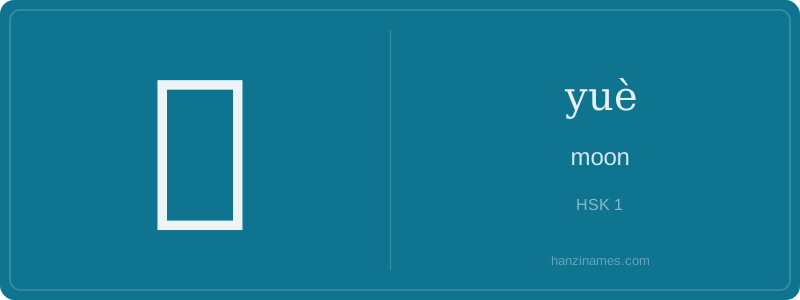
In daily life, 月 is indispensable: it appears in all dates (e.g., 10月 for 'October'), monthly reports (月报), salary slips (月薪), and idioms like 海底捞月 (hǎidǐ lāo yuè, 'fishing for the moon'—a futile effort). Historically, the lunar calendar governed imperial taxation, harvest festivals, and the Mid-Autumn Festival—documented since the Han dynasty (206 BCE–220 CE).
The character originated as a pictograph: oracle-bone inscriptions show a crescent with a central dot or line, representing the moon’s illuminated portion. Later forms simplified this into the modern four-stroke structure—still evoking the moon’s curved shape, though now highly stylized and standardized by the Qin dynasty’s script unification (c. 220 BCE).
As an archaeologist brushing dust from a Shang dynasty oracle bone, I trace the earliest known form of 月—a simplified crescent with a central line—carved over 3,200 years ago. This wasn’t mere decoration; it was calendrical notation, aligning agricultural rites and royal divinations with lunar cycles. The character’s concave shape mirrors the waxing crescent visible in northern China’s clear night skies—a deliberate, observational abstraction that predates standardized script by centuries.
By the Zhou dynasty, 月 evolved into a more symmetrical, enclosed form on bronze inscriptions—still unmistakably lunar, yet increasingly stylized. Scribes began using it not only for the celestial body but also as a temporal marker: ‘one moon’ meant one month, embedding timekeeping into writing itself. This semantic expansion reveals how deeply astronomy shaped early Chinese bureaucracy, law, and ritual—where missing a lunar appointment could mean political peril.
What astonishes me is its resilience: unlike many ancient characters altered beyond recognition, 月 has retained its core visual logic across three millennia. Even today’s standard form—four clean strokes forming a tall, slender crescent—echoes that first oracle-bone silhouette. It stands as rare archaeological continuity: a living fossil of proto-scientific observation, preserved not in museum glass, but in every child’s handwriting and smartphone text message.
Example Sentences
Common Compounds
Similar Characters — Don't Mix These Up
Your First Step into Chinese Culture: Get a Chinese Name
Every journey into Chinese begins with a name. Use our free Chinese name generator to create a meaningful, personalized Chinese name that fits you perfectly.
Get My Chinese Name →