孝
Character Story & Explanation
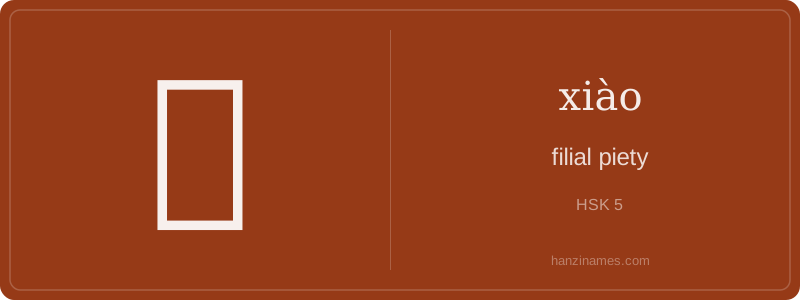
孝 is central to Chinese legal and social frameworks: China’s 2013 Elderly Rights Law explicitly requires adult children to ‘visit or call aging parents frequently,’ citing 孝 as cultural foundation. It appears in idioms like 百善孝为先 (bǎi shàn xiào wéi xiān, ‘of all virtues, filial piety comes first’)—a phrase quoted in official speeches and school textbooks since the Ming dynasty. Modern usage includes formal contexts like 孝敬 (xiàojìng, ‘to respectfully serve elders’) and bureaucratic terms like 孝道教育 (xiàodào jiàoyù, ‘filial piety education’).
The character’s form is a clear semantic compound: 老 (old person) over 子 (child), first attested in seal script (c. 3rd century BCE). Unlike oracle-bone characters, no pictographic precursor exists—its earliest forms already convey relational hierarchy through spatial composition, not visual mimicry.
As an archaeologist sifting through bamboo slips from the Warring States period, I found 孝 inscribed in ink that had bled slightly—evidence of careful, reverent copying. Its early forms show no divine mandate but a human posture: elder above, child below. This wasn’t abstract philosophy carved in stone; it was a daily covenant written on perishable media, meant to be read aloud during ancestral rites and taught in village schools.
The character’s structure—老 (lǎo, ‘elder’) atop 子 (zǐ, ‘child’)—emerged fully by the Han dynasty, not as a pictograph but as a semantic compound. Excavated Mawangdui texts reveal 孝 as a performative verb: not just ‘feeling respect,’ but ‘serving parents with warm porridge at dawn,’ ‘reporting dreams of ancestors to elders,’ ‘postponing one’s own marriage until siblings wed.’ Ritual action preceded moral abstraction.
In Tang-dynasty Dunhuang manuscripts, 孝 appears in ‘filial piety illustrations’—not as stern command, but as narrative scenes: a son warming his father’s bed with his body in winter (‘lying-on-ice carp’ stories). These weren’t myths, but pedagogical tools for literacy and ethics. The character’s endurance lies not in dogma, but in its adaptability: Confucius framed it as root of virtue; Neo-Confucians codified it into law; modern reformers critiqued its rigidity—yet it remains embedded in family registries, elder-care policies, and funeral eulogies.
Example Sentences
Common Compounds
Similar Characters — Don't Mix These Up
Your First Step into Chinese Culture: Get a Chinese Name
Every journey into Chinese begins with a name. Use our free Chinese name generator to create a meaningful, personalized Chinese name that fits you perfectly.
Get My Chinese Name →