寂
Character Story & Explanation
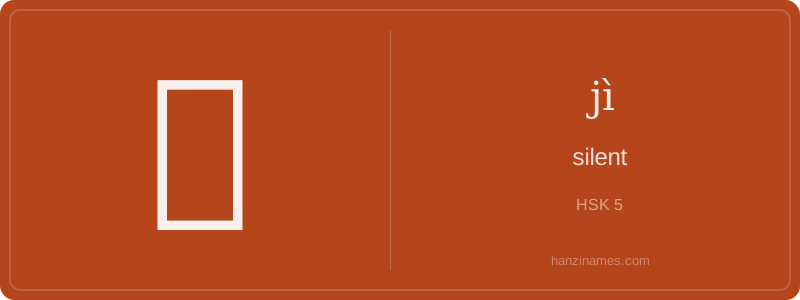
寂 appears frequently in classical poetry, Buddhist texts, and modern literary Chinese. It’s central in idioms like 寂然无声 (jìrán wúshēng, 'utterly silent') and the compound 寂寞 (jìmò), listed in the HSK 5 syllabus and used daily to express emotional solitude. Historically, Tang dynasty poets like Wang Wei employed 寂 to evoke meditative landscapes—e.g., '空山不见人,但闻人语响。返景入深林,复照青苔上。' (Empty mountains—no one in sight; yet voices echo…)
The character combines 宀 (mián, 'roof') and 又 (yòu, originally a hand, later phonetic). While early forms are not pictographic, its structure suggests 'stillness under shelter'—a documented semantic-phonetic compound (形声字) from the Warring States period onward. Today, Chinese learners encounter it first in contexts like '寂静的夜晚' (a quiet night) or '寂寥的古寺' (a secluded ancient temple).
寂 (jì) conveys a profound, often poetic silence—not merely absence of sound, but a stillness imbued with introspection, solitude, or spiritual calm. Unlike English 'silent', which is primarily descriptive or functional (e.g., 'silent alarm'), 寂 carries aesthetic and philosophical weight, especially in Daoist, Chan Buddhist, and classical literary traditions where quietude signifies depth, authenticity, and harmony with nature.
In Chinese aesthetics, 寂 frequently pairs with 寞 (mò) to form 寂寞 (jìmò), meaning 'loneliness'—but this is not the hollow ache of Western individualism. Rather, it evokes a contemplative, almost dignified solitude: think of a lone scholar under a pine tree at dusk, or an ink-wash painting’s vast empty space (留白). Silence here is active, resonant, and generative.
Western equivalents like 'serene', 'hushed', or 'tranquil' capture tone but miss cultural nuance. 'Silent' in English often implies suppression (e.g., 'silenced voice') or dysfunction ('awkward silence'), whereas 寂 is rarely negative—it can be sacred, elegant, or even joyful in its stillness. This reflects a broader East Asian valuing of restraint, subtlety, and inner resonance over vocal assertion.
Example Sentences
Common Compounds
Similar Characters — Don't Mix These Up
Your First Step into Chinese Culture: Get a Chinese Name
Every journey into Chinese begins with a name. Use our free Chinese name generator to create a meaningful, personalized Chinese name that fits you perfectly.
Get My Chinese Name →