寓
Character Story & Explanation
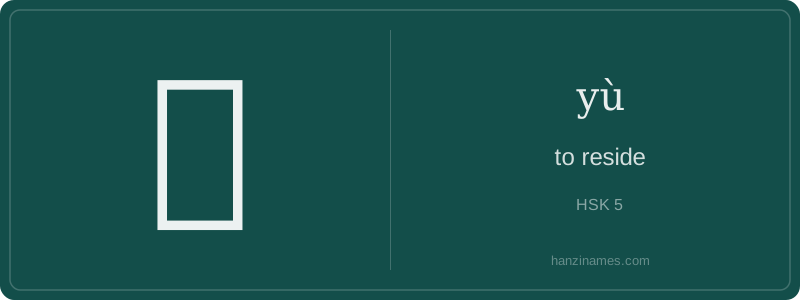
In modern Chinese, 寓 most commonly appears in real estate and administrative contexts: ‘apartment’ (公寓 gōngyù), ‘rental unit’ (寓所 yùsuǒ), and ‘residence permit’ (居留许可, though 寓 appears in older legal documents like 寓居证). It’s central to the idiom 寓教于乐 (yù jiào yú lè)—‘to embed education in entertainment’—a Confucian pedagogical principle documented since the Song dynasty and still cited in MOE curriculum guidelines.
The character’s seal script form (c. 3rd c. BCE) clearly shows 宀 over 偶—no disputed oracle-bone origin exists for 寓, as it first appears in Warring States bamboo texts. Today, Chinese people routinely encounter it on apartment building signs, rental contracts, and cultural slogans—making it a quiet yet omnipresent marker of inhabited space and embedded meaning.
As an archaeologist brushing dust from a Han dynasty bamboo slip, I find 寓 etched not as a mere verb but as a conceptual dwelling—its 宀 (roof) radical anchoring it in the ancient Chinese worldview where shelter was sacred. Beneath the roof lies 偶 (ǒu), originally meaning 'image' or 'statue', later evolving to suggest 'occasional' or 'by chance'. This pairing reveals an early semantic layer: to reside is not just physical occupation, but *temporary, intentional habitation*—like housing a spirit tablet or lodging a guest.
Excavations at Mawangdui revealed texts using 寓 to describe ritual residence—e.g., spirits ‘residing’ in ancestral tablets during ceremonies. Unlike 居 (jū), which denotes permanent settlement, 寓 carries connotations of transience and purposeful placement. Its 12-stroke form stabilized by the Eastern Han, shedding earlier variants with 禺 or 遇 components—evidence of standardization driven by bureaucratic record-keeping.
The character’s evolution mirrors China’s urbanization: as cities grew, 寓 shifted from ritual and diplomatic contexts (e.g., envoys ‘residing’ in guest quarters) toward literary abstraction. By the Tang, poets used it metaphorically—‘the mind resides in stillness’—foreshadowing its modern use in abstract compounds like 寓意 (yùyì, ‘implied meaning’). Its radical 宀 remains a silent witness: every time we write 寓, we inscribe a roof over meaning itself.
Example Sentences
Common Compounds
Similar Characters — Don't Mix These Up
Your First Step into Chinese Culture: Get a Chinese Name
Every journey into Chinese begins with a name. Use our free Chinese name generator to create a meaningful, personalized Chinese name that fits you perfectly.
Get My Chinese Name →