寞
Character Story & Explanation
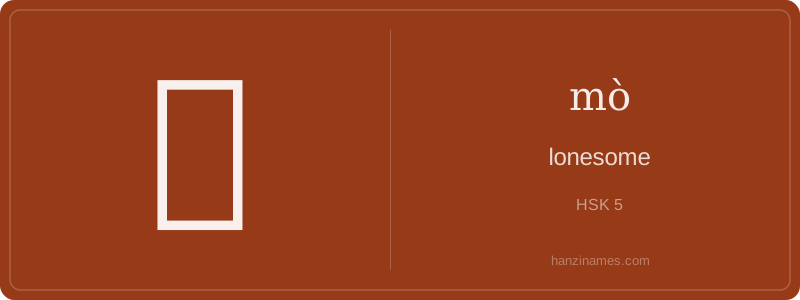
寞 is rarely used alone in contemporary Mandarin; it appears almost exclusively in compound words like 寂寞 (jìmò, 'loneliness') or in literary expressions such as ‘落寞’ (luòmò, 'melancholy desolation'). It features in Tang and Song dynasty poetry to evoke refined sorrow—e.g., Li Qingzhao’s ci poems use 寞 to express post-war grief and personal loss. Modern writers like Eileen Chang deploy it for psychological nuance, never colloquial bluntness.
寞 evolved from the ancient character 莫 (originally depicting the sun setting beneath grass, meaning 'dusk' or 'not'), later borrowing its sound and acquiring the 宀 roof radical to emphasize interiority. Its current form (宀 + 莫) was standardized in clerical script by the Han dynasty—documented in Shuōwén Jiězì (100 CE) as 'quiet, silent, secluded.' No oracle bone form survives; its earliest attested use is in bronze inscriptions of the Warring States period.
寞 (mò) embodies a quiet, introspective solitude—less about physical isolation and more about inner stillness and emotional resonance with emptiness. In Chinese philosophy, such stillness isn’t negative; it echoes Daoist wu wei (effortless action) and Chan Buddhist mindfulness, where silence becomes fertile ground for clarity. This character reflects a cultural comfort with absence—not as lack, but as presence in another form.
The radical 宀 (mián), meaning 'roof' or 'house', frames 寞’s meaning: lonesomeness experienced *within* sheltered space—suggesting safety amid solitude. The right side, 莫 (mò), originally meant 'sunset' (now a homophone for 'not'), implying twilight’s hush—the liminal hour when external noise fades and internal awareness deepens. Thus, 寞 is not despair, but dignified quietude.
In modern usage, 寞 carries poetic weight and literary refinement. It appears more often in essays, lyrics, and classical-inspired prose than in casual speech—marking a speaker’s sensitivity and education. Its rarity in daily talk underscores its cultural status: not mere loneliness, but a cultivated, almost aesthetic state—like the empty space in ink-wash painting (留白 liúbái), where meaning breathes in the unsaid.
Example Sentences
Common Compounds
Similar Characters — Don't Mix These Up
Your First Step into Chinese Culture: Get a Chinese Name
Every journey into Chinese begins with a name. Use our free Chinese name generator to create a meaningful, personalized Chinese name that fits you perfectly.
Get My Chinese Name →