宁
Character Story & Explanation
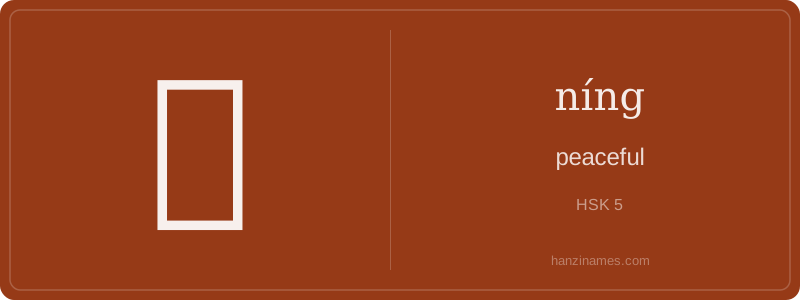
宁 (níng) is ubiquitous in modern Chinese: it appears in place names like Ningbo (宁波, ‘Tranquil Waves’) and Ningxia (宁夏, ‘Peaceful Xia’), and in formal contexts like 宁静 (nínjìng, ‘serenity’) and 安宁 (ānníng, ‘peace and tranquility’). It features in the idiom 宁死不屈 (nìng sǐ bù qū, ‘rather die than surrender’), illustrating its emphatic nìng reading. Historically, 宁 was adopted as the simplified form of 寧 in the 1956 reform — a documented, state-mandated change, not an organic evolution.
The character’s structure is not pictographic but semantic-phonetic: 宀 (roof) signals meaning related to shelter/stability; 丁 (dīng) originally served as a phonetic component (though pronunciation diverged). No oracle bone or bronze inscriptions attest to 宁 itself — it emerged later as a simplification. Today, Chinese learners first encounter it in HSK 5 vocabulary like 心宁 (xīn níng, ‘calm heart’), reflecting its enduring cultural role in articulating inner peace.
As a linguistic detective, I begin with the seal script (c. 3rd century BCE), where 宁 appears as a simplified variant of 寧 — featuring the roof radical 宀 over 丁 (a nail or stake), symbolizing stability under shelter. This reflects an ancient conceptual link: peace as security within a protected space, not mere quietude. The character’s minimal stroke count (5) belies its semantic weight — it distills a foundational Confucian ideal: inner and societal calm anchored in order and propriety.
The evolution from 寧 to 宁 is a story of bureaucratic streamlining: during the 1956 Chinese Character Simplification Scheme, 寧 was officially replaced by 宁 in mainland China. While traditional forms persist in Taiwan and Hong Kong, 宁 became the standardized HSK-5 character — signaling both linguistic modernization and ideological emphasis on accessible, harmonious language. Its radical 宀 (roof) consistently anchors meanings tied to dwelling, safety, and containment.
Phonetically, níng (peaceful) and nìng (would rather) are homographs with distinct grammatical roles — a classic case of *polyphony* in Chinese. The nìng reading functions as an adverb expressing volition or preference (e.g., 宁可 ‘would rather’), preserved from Classical Chinese syntax. This duality isn’t arbitrary: both senses stem from the root idea of *choosing stillness* — whether choosing peace over chaos, or choosing one option over another with resolve.
Example Sentences
Common Compounds
Similar Characters — Don't Mix These Up
Your First Step into Chinese Culture: Get a Chinese Name
Every journey into Chinese begins with a name. Use our free Chinese name generator to create a meaningful, personalized Chinese name that fits you perfectly.
Get My Chinese Name →