宽
Character Story & Explanation
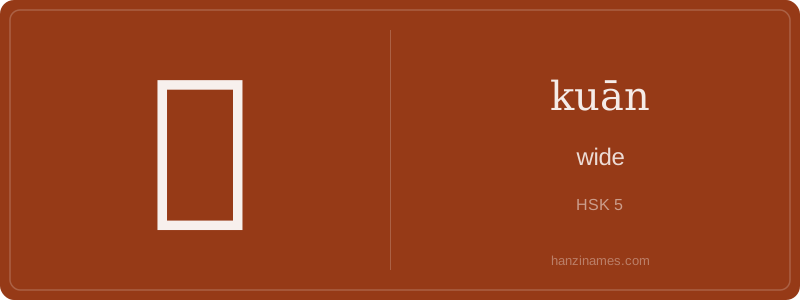
宽 appears in foundational texts like the Analects (e.g., 子曰:‘宽则得众’ — ‘Leniency wins the people’), establishing its early association with virtuous governance. Today, it’s ubiquitous: used in official policy rhetoric (e.g., 宽严相济 ‘combining leniency and strictness’ in judicial reform), education (宽进严出 ‘broad admission, strict graduation’), and daily speech (别太紧张,放宽心 ‘Don’t stress—relax your mind’). The idiom 宽以待人、严以律己 (‘Be lenient toward others, strict with oneself’) remains a cornerstone of Chinese professional ethics.
Graphically, 宽 is a phono-semantic compound: 宀 (roof radical, indicating shelter/home) + 艹 (grass, historically part of the phonetic component , now simplified to variation of 廾) + 见 (to see). Its earliest attested form in seal script (c. 3rd century BCE) already shows the roof radical atop a phonetic element suggesting ‘spaciousness under cover’—reflecting ancient associations between architectural openness and social benevolence.
The Chinese character 宽 (kuān) conveys the core idea of 'wide'—but extends far beyond physical breadth. In Chinese thought, width symbolizes generosity, tolerance, and mental spaciousness. Unlike English, where 'wide' is mostly spatial (e.g., wide road), 宽 frequently describes moral and emotional qualities: a 'wide heart' (宽心) means calm confidence; 'being lenient' is 宽容 (kuān róng). This semantic expansion reflects Confucian values that equate spatial openness with ethical openness.
Western equivalents like 'broad' or 'spacious' carry some overlap—but lack the consistent moral weight. In English, 'broad-minded' implies tolerance, yet it’s idiomatic and optional; in Chinese, 宽 is *grammatically embedded* in moral vocabulary (e.g., 宽厚 'kind and tolerant', 宽待 'treat leniently'). There’s no neutral usage: even 'wide screen' (宽屏) subtly evokes expansiveness as a virtue—not just measurement.
Culturally, 宽 resonates with Daoist and Buddhist ideals of non-attachment and mental freedom. A 'wide mind' (宽心) isn’t passive—it’s an active cultivation of resilience. Compare this to Western individualism, where 'open-mindedness' often centers on intellectual flexibility, while 宽 emphasizes relational harmony and self-restraint. Thus, 宽 is less about cognitive range and more about creating psychological and social room for others—a deeply relational concept rooted in East Asian ethics.
Example Sentences
Common Compounds
Similar Characters — Don't Mix These Up
Your First Step into Chinese Culture: Get a Chinese Name
Every journey into Chinese begins with a name. Use our free Chinese name generator to create a meaningful, personalized Chinese name that fits you perfectly.
Get My Chinese Name →