岸
Character Story & Explanation
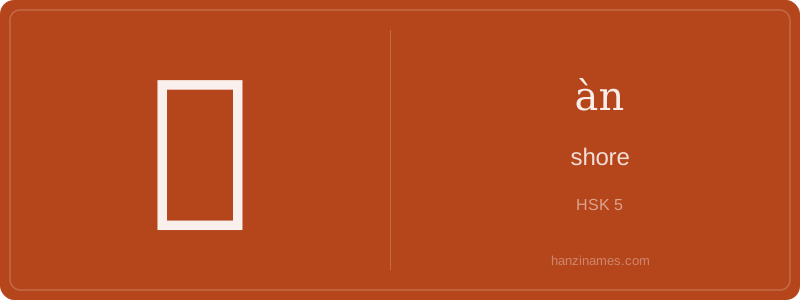
岸 appears frequently in geographical names (e.g., 大连岸 Dàlián àn — Dalian shoreline), official documents on maritime sovereignty, and idioms like 悬崖勒马 (xuán yá lè mǎ — 'rein in at the cliff edge'), where 岸’s semantic field overlaps with perilous edges. It’s central in the HSK-5 idiom 彼岸花开 (bǐ àn huā kāi — 'flowers bloom on the other shore'), referencing Buddhist enlightenment. Historically, the term 岸防 (àn fáng, coastal defense) dates to Ming dynasty naval records.
岸 is a phono-semantic compound: 山 (shān, mountain) as semantic radical signals terrain-related meaning, while 干 (gān, originally 'dry') serves as the phonetic component (though pronunciation shifted to àn). Its earliest attested form appears in bronze inscriptions of the late Zhou dynasty, depicting a hill beside flowing water — a clear topographic reference to elevated land bordering rivers or seas.
The character 岸 (àn) embodies a foundational spatial concept in Chinese cosmology: the boundary where land meets water — not as a line of separation, but as a dynamic interface of stability and flow. In classical thought, mountains (山, the radical) symbolize enduring virtue and moral uprightness, while water represents change and wisdom. Thus, 岸 subtly encodes Confucian ideals — the shore is where the cultivated person stands firm yet remains responsive to life’s currents.
Unlike Western binaries of land/water or safety/chaos, 岸 carries quiet authority: it is neither fully mountain nor river, but the grounded vantage from which one observes, reflects, and acts. This resonates in poetry and governance alike — emperors commissioned ‘shore inspections’ (巡岸) to affirm territorial integrity, while poets like Du Fu used 岸 to mark moments of clarity amid turmoil, suggesting inner composure anchored in principle.
In modern usage, 岸 retains this duality of physical place and metaphorical stance. Phrases like ‘靠岸’ (to dock) imply resolution or return; ‘彼岸’ (the other shore) evokes Buddhist transcendence — not escape, but mindful crossing. The character thus reveals a worldview where boundaries are not walls but thresholds: places of transition, responsibility, and quiet strength — always rooted in the mountain’s steadfastness, yet facing the sea’s boundless possibility.
Example Sentences
Common Compounds
Similar Characters — Don't Mix These Up
Your First Step into Chinese Culture: Get a Chinese Name
Every journey into Chinese begins with a name. Use our free Chinese name generator to create a meaningful, personalized Chinese name that fits you perfectly.
Get My Chinese Name →