巨
Character Story & Explanation
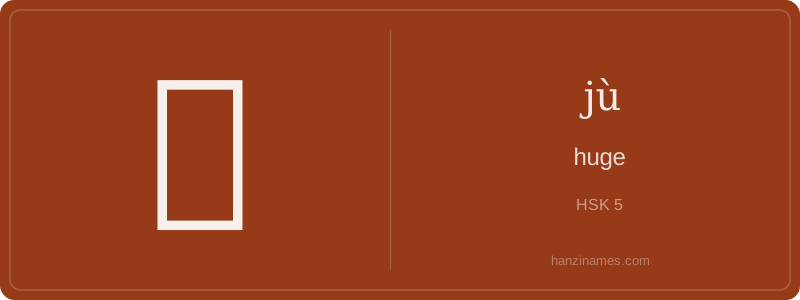
In modern Chinese, 巨 appears frequently in formal and media contexts to denote exceptional scale: news headlines say ‘巨幅增长’ (massive growth) for GDP surges, or ‘巨灾’ (catastrophic disaster) for earthquakes exceeding magnitude 7. It’s central in the idiom ‘巨人肩膀’ (shoulders of giants), referencing Newton’s famous quote—widely taught in Chinese science education since the 1980s. The term 巨头 (jùtóu, ‘industry titan’) is ubiquitous in business reporting, denoting dominant firms like Alibaba or Tencent.
The character’s earliest confirmed form appears in Warring States bamboo manuscripts (4th c. BCE) as a simplified variant of the older character 擧 (to lift), where the upper part was reduced and enclosed by 匚. Scholars agree it evolved graphically—not as a pictograph of a person—but as a functional abbreviation emphasizing *contained magnitude*, later semantically specialized to ‘tremendous’.
As an archaeologist brushing dust from a Han dynasty bamboo slip, I find 巨 inscribed with startling clarity—not as a pictograph of a giant, but as a carefully bounded enclosure (匚) containing a vertical stroke. This minimalist form suggests containment of magnitude: not raw size, but *measured enormity*, like a granary holding surplus grain or a walled city defining sovereign scale. Its four-stroke austerity contrasts with later ornate variants, revealing early Chinese conceptual precision: bigness must be framed, not merely asserted.
The radical 匚—‘enclosure’—anchors 巨 in spatial and administrative logic. Unlike descriptive characters like 大 (big), 巨 implies *functional scale*: something so large it requires boundaries, oversight, or institutional recognition. Excavated legal texts from Zhangjiashan (2nd c. BCE) use 巨 to quantify ‘excessive’ fines or ‘tremendous’ harvest shortfalls—always in contexts demanding official judgment. This isn’t poetic hyperbole; it’s bureaucratic calibration of the colossal.
Even in Tang steles and Song printing blocks, 巨 retains its structural gravity. It rarely stands alone; instead, it compounds with nouns (巨龙, 巨浪) or verbs (巨大化) to denote scale that disrupts norms—like a flood breaching dikes or a merchant’s wealth eclipsing local gentry. Its HSK 5 placement reflects this semantic weight: learners encounter it not in beginner descriptions, but in advanced discourse on societal transformation, ecological crisis, or technological leap—where ‘huge’ carries consequence, not just size.
Example Sentences
Common Compounds
Similar Characters — Don't Mix These Up
Your First Step into Chinese Culture: Get a Chinese Name
Every journey into Chinese begins with a name. Use our free Chinese name generator to create a meaningful, personalized Chinese name that fits you perfectly.
Get My Chinese Name →