府
Character Story & Explanation
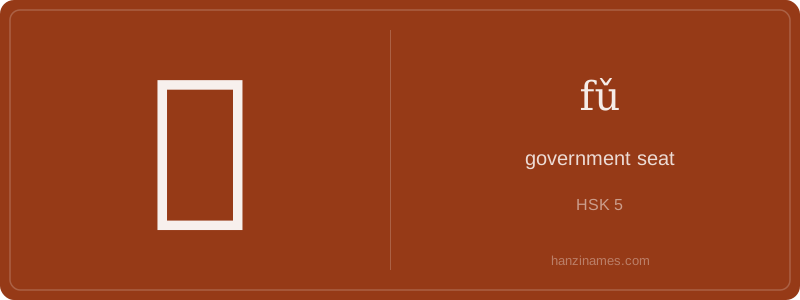
In modern China, 府 appears most commonly in formal administrative titles and historical place names. The term ‘municipal government’ is officially translated as 市政府 (shì rénmín zhèngfǔ), where 政府 (zhèngfǔ) means ‘government’—a compound used daily in news, official documents, and public signage. Well-known phrases include ‘the seat of government’ (政府所在地) and idioms like 府仰之间 (fǔyǎng zhī jiān), meaning ‘in the blink of an eye’, though this uses a homophone 俯. Historically, during the Ming and Qing dynasties, 府 was a key administrative tier—e.g., Suzhou Prefecture (苏州府) governed dozens of counties.
The character’s form is not pictographic but phono-semantic: 广 (roof radical, indicating ‘place’) + 付 (fù, phonetic component and semantic hint meaning ‘to assign’). No oracle bone or bronze script form survives; its earliest attestation is in Warring States bamboo texts. Today, Chinese people see 府 most often in 政府 (zhèngfǔ)—on street banners, WeChat government service accounts, and ID card issuance notices.
The character 府 (fǔ) evokes the grandeur of imperial administration and modern civic authority. Historically, it denoted a regional government office—like a prefecture or magistrate’s yamen—often housed in a walled compound with ceremonial gates and courtyard halls. Its presence signaled official power, legal jurisdiction, and tax collection. Even today, the character carries weight: seeing 府 on a building sign immediately tells Chinese citizens this is no ordinary office—it’s where policy is enacted and permits are issued.
Visually, 府 belongs to the 广 (guǎng, 'broad') radical—a roof-like structure suggesting shelter, coverage, and institutional scope. Beneath it lies 付 (fù), meaning 'to entrust' or 'hand over', reinforcing the idea of delegated authority. This composition reflects Confucian governance ideals: power entrusted by the emperor (or people) to administer justice and manage resources within a defined territory.
Though largely replaced by 省 (shěng, province) and 市 (shì, city) in contemporary administrative nomenclature, 府 persists in formal, historical, and honorific contexts. It appears in place names like Shaoxing Prefecture (绍兴府, now a prefecture-level city), in classical literature, and in diplomatic titles such as 外交部 (wàijiāobù, Ministry of Foreign Affairs)—where 部 (bù) has superseded 府 but the semantic legacy remains intact.
Example Sentences
Common Compounds
Similar Characters — Don't Mix These Up
Your First Step into Chinese Culture: Get a Chinese Name
Every journey into Chinese begins with a name. Use our free Chinese name generator to create a meaningful, personalized Chinese name that fits you perfectly.
Get My Chinese Name →