厢
Character Story & Explanation
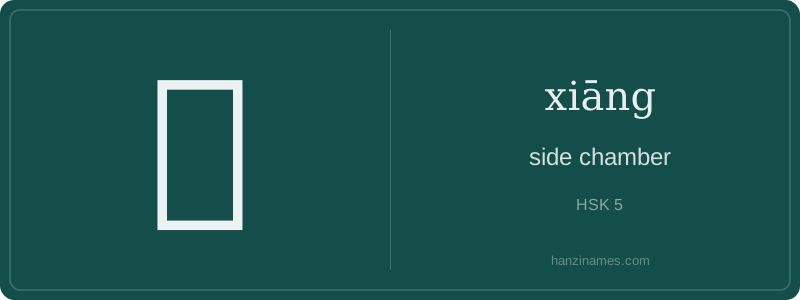
In contemporary China, 厢 appears most frequently in transportation and entertainment contexts: railway carriages (车厢), private karaoke booths (包厢), and theater balcony boxes (包厢 or 楼厢). It’s also used in historical preservation signage for traditional courtyard houses (东厢房, 'east side chamber'). The term 车厢 is standard on all China Railway announcements and tickets—verified in official CR documents and station displays since the 1950s.
The character 厢 is not a pictograph but a phono-semantic compound: radical 厂 (suggesting a sheltered, overhanging space) + phonetic 相 (xiāng, indicating pronunciation). Its earliest attested use appears in Tang dynasty texts describing residential architecture, later codified in Song dynasty building manuals like the Yingzao Fashi. No oracle bone or bronze inscriptions contain this character—it emerged after the Qin unification.
Imagine stepping into a traditional Beijing siheyuan courtyard house—its gray-brick walls, carved wooden doors, and symmetrical layout whisper centuries of history. As you walk past the main hall, you notice two side buildings flanking it: the east and west 'xiāng'. These aren’t just rooms—they’re architectural units with distinct names and functions, rooted in classical Chinese spatial philosophy where balance and hierarchy shape daily life.
The character 厢 (xiāng) originally referred to these side chambers in courtyard residences, not generic 'boxes'. Over time, its meaning extended metaphorically: train compartments ('train box'), theater balconies ('box seats'), and even digital storage spaces ('inbox'). This semantic expansion reflects how Chinese language adapts ancient spatial concepts to modern contexts—turning architecture into abstraction.
Despite its HSK 5 status, 厢 is rarely used alone in speech—it almost always appears in compounds like 车厢 (chēxiāng, 'railway carriage') or 包厢 (bāoxiāng, 'private viewing booth'). Its radical 厂 (hǎn), meaning 'cliff' or 'overhanging rock', hints at sheltered space—fitting for enclosed, protected areas. Learners should note that while dictionaries list 'box' as a basic meaning, native usage emphasizes enclosure, separation, and designated function—not container shape.
Example Sentences
Common Compounds
Similar Characters — Don't Mix These Up
Your First Step into Chinese Culture: Get a Chinese Name
Every journey into Chinese begins with a name. Use our free Chinese name generator to create a meaningful, personalized Chinese name that fits you perfectly.
Get My Chinese Name →