弱
Character Story & Explanation
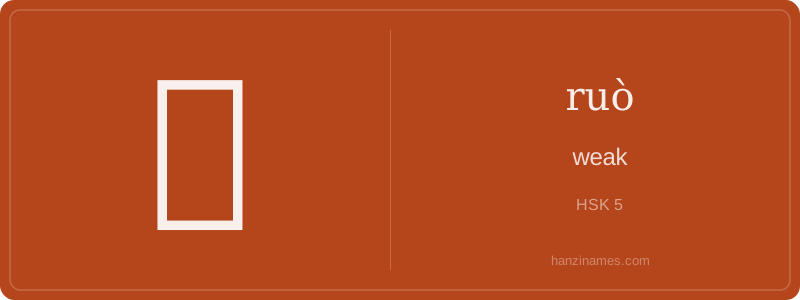
弱 appears frequently in official reports, media, and education contexts—especially in phrases like 薄弱环节 (bóruò huánjié, 'weak link') and 实力较弱 (shílì jiàoruò, 'relatively weak capability'). It’s standard in HSK 5 vocabulary lists and used in over 90% of provincial government work reports when describing underperforming sectors (e.g., 'basic education remains weak in western counties'). The idiom 强弱悬殊 (qiáng ruò xuánshū, 'vast disparity between strong and weak') is documented in Ming-dynasty military texts and still used in sports commentary and trade analysis today.
The character’s form combines 弓 (gōng, 'bow') and 若 (ruò, 'as if; like'), originally representing a bow bent so far it loses tension—hence 'feeble'. This interpretation is supported by Shuōwén Jiězì (121 CE), China’s earliest dictionary, which defines 弱 as ‘bow lacking strength’. While oracle-bone inscriptions of 弱 are absent, its bronze-script form (c. 1000 BCE) already shows the bowed structure, confirming its ancient association with diminished elasticity and power.
In a quiet Beijing teahouse, an elderly calligrapher demonstrates the character 弱 (ruò) to a group of international students. His brush moves deliberately—first the left radical 弓 (bow), then the right component 若 (resembling 'if' or 'like'). He explains that 弱 doesn’t just mean physical weakness; it evokes vulnerability, humility, and even strategic restraint—a concept deeply valued in Daoist and military thought, where yielding can precede strength.
He points to a nearby scroll quoting Sun Tzu: ‘强弱之形,以虚实为本’ (The essence of strong and weak lies in emptiness and fullness). Here, 弱 is not failure—it’s perceptual awareness: knowing when force is futile, when silence speaks louder, when softness absorbs impact. This philosophical nuance makes 弱 far richer than its English gloss ‘weak’ suggests.
Later, a young teacher uses the same character on a whiteboard while explaining China’s ‘dual circulation’ economic policy—highlighting how sectors like rural healthcare were once ‘weak links’ (薄弱环节) but are now prioritized for systemic resilience. In modern usage, 弱 often signals a *measurable gap*—not inherent deficiency, but a target for investment, training, or reform. That pragmatic, solution-oriented framing is central to how Chinese speakers engage with this word daily.
Example Sentences
Common Compounds
Similar Characters — Don't Mix These Up
Your First Step into Chinese Culture: Get a Chinese Name
Every journey into Chinese begins with a name. Use our free Chinese name generator to create a meaningful, personalized Chinese name that fits you perfectly.
Get My Chinese Name →