念
Character Story & Explanation
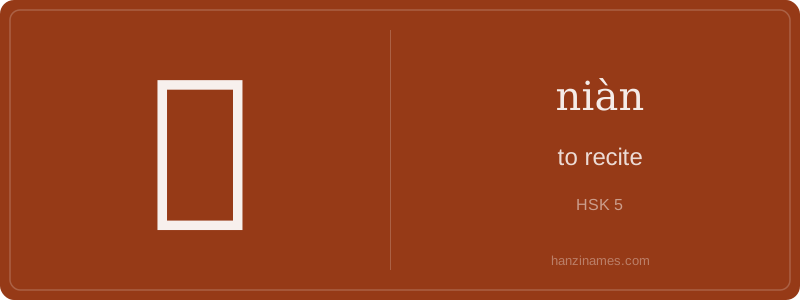
In daily life, 念 is ubiquitous in education, religion, and personal expression. Students ‘recite’ vocabulary (念单词, niàn dāncí); Buddhists ‘chant’ mantras (念佛, niàn fó); elders say 念旧 (niàn jiù, 'to cherish the past'). It appears in HSK 5–6 vocabulary and official language exams. Historically, Tang dynasty steles and Song dynasty printing records show 念 used in 'reading aloud for comprehension'—distinct from silent reading, which only became common much later.
The character is not pictographic—it evolved from Zhou bronze inscriptions as a phono-semantic compound. The top 今 likely provided sound (Old Chinese *kəm), while 心 conveyed the mental domain. No oracle bone form survives, but early Warring States bamboo slips confirm its use for 'reciting with intent', validating its core semantic link to conscious, voiced thought.
As a linguistic detective, I begin with the modern form of 念: eight strokes, heart radical (心) at the bottom, and 今 above it. At first glance, it looks like a phonetic-semantic compound—common in Chinese characters—but its story is more nuanced. The heart radical signals an internal, mental activity, not just emotion. This hints that 念 was never merely about vocalization; it’s about cognition anchored in awareness, intention, or memory.
Historically, 念 appears consistently in Warring States bamboo texts and Han dynasty manuscripts meaning 'to recite', 'to ponder', or 'to remember'. Crucially, it was used for ritual recitation—Buddhist sutras, Confucian classics—where reading aloud was inseparable from contemplative absorption. Unlike characters like 读 (dú, 'to read') which emphasize decoding text, 念 implies engaged, mindful repetition—think chanting a mantra or rehearsing lines with emotional weight.
The character’s stability across 2,300 years is remarkable: no major shape shifts occurred from seal to clerical to regular script. Its composition—今 (jīn, 'now') + 心—suggests 'mindfulness in the present moment', a semantic resonance later amplified by Buddhist usage in China. While 今 may have originally served as a phonetic hint (both 今 and 念 had similar Old Chinese pronunciations), the visual pairing powerfully reinforced meaning: reading as an act of embodied, attentive presence—not passive scanning, but active mental holding.
Example Sentences
Common Compounds
Similar Characters — Don't Mix These Up
Your First Step into Chinese Culture: Get a Chinese Name
Every journey into Chinese begins with a name. Use our free Chinese name generator to create a meaningful, personalized Chinese name that fits you perfectly.
Get My Chinese Name →