忽
Character Story & Explanation
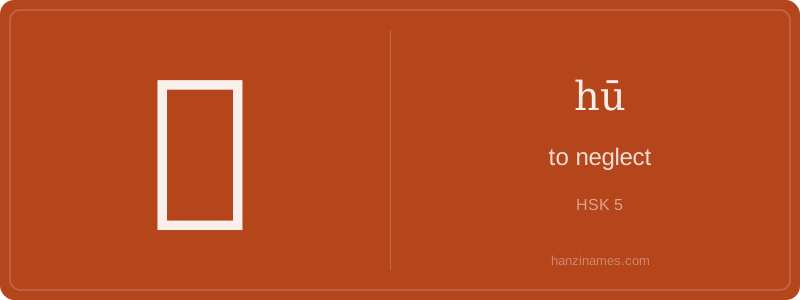
忽 is widely used in modern Chinese to express oversight or negligence — especially in formal, academic, or bureaucratic contexts. It appears in key idioms like 忽略不计 (hūlüè bù jì, 'to disregard entirely') and historical phrases such as 忽微 (hū wēi, 'neglecting trifles', from Ouyang Xiu’s famous essay). Government documents, safety guidelines, and education policy frequently warn against 忽视安全 ('neglecting safety'). The character also features in classical poetry, where 忽 often conveys suddenness — e.g., 忽见 (hū jiàn, 'suddenly see') — showing semantic flexibility beyond 'neglect'.
The character 忽 first appeared in seal script during the Warring States period. Its right side is the phonetic component 勿 (wù), while the left is the heart radical (心), indicating mental/emotional involvement. Unlike pictographic characters (e.g., 日 for 'sun'), 忽 is a phono-semantic compound — no object is drawn; instead, it signals *mental action* (or inaction) through structure and sound.
Hello students! Today we’ll explore the character 忽 (hū), which means 'to neglect' or 'to overlook'. It’s an HSK Level 5 character — not among the earliest you’ll learn, but very useful for expressing carelessness, suddenness, or unintentional omission. Though it looks simple (just 8 strokes), its meaning carries emotional weight: forgetting something important, ignoring a warning, or missing a chance. The heart radical (心) reminds us that neglect often starts in the mind — a lapse in attention or intention.
Don’t confuse 忽 with similar-sounding characters like 呼 (hū, 'to shout') or 胡 (hú, 'nonsense'). Its pronunciation is steady and light, like a soft exhale — think 'hoo' as in 'hush', not 'whoa'. In spoken Mandarin, 忽 often appears in compound words rather than alone, especially in formal or literary contexts. You’ll hear it in phrases like 忽略 (hūlüè, 'to ignore') or 忽视 (hūshì, 'to disregard'), both common in news reports, essays, and workplace feedback.
Writing 忽 reinforces mindfulness: every stroke matters. Start with the left-side 'heart' radical (⺗), then add the right component — which is actually the ancient form of 忽 itself, derived from the phonetic element 勿 (wù, 'do not'). This tells us 忽 carries a sense of *intentional non-action*: not just forgetting, but failing to act when you should. As learners, practicing this character helps build awareness — both of writing discipline and of how language reflects responsibility.
Example Sentences
Common Compounds
Similar Characters — Don't Mix These Up
Your First Step into Chinese Culture: Get a Chinese Name
Every journey into Chinese begins with a name. Use our free Chinese name generator to create a meaningful, personalized Chinese name that fits you perfectly.
Get My Chinese Name →