怨
Character Story & Explanation
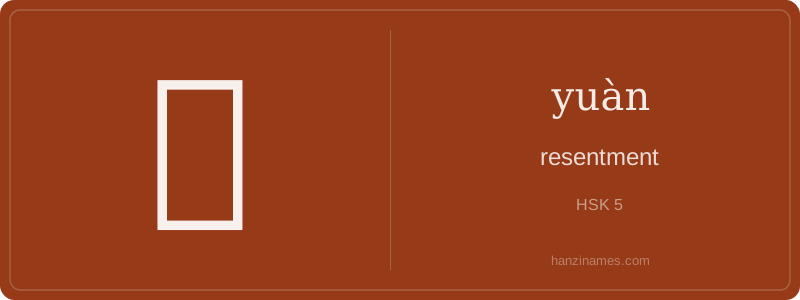
怨 appears frequently in classical and modern Chinese in expressions of moral grievance and interpersonal tension. It’s central in idioms like 怨天尤人 (yuàn tiān yóu rén, 'blame heaven and fault others'), documented since the Song dynasty, describing deflection of responsibility. In contemporary life, 怨 commonly surfaces in counseling contexts, workplace feedback ('他心里有怨气' — 'He harbors resentment'), and family narratives about generational sacrifice. The *Zuo Zhuan* (c. 4th c. BCE) records ministers warning rulers against policies that 'engender 怨 among the people' — showing its early use in political ethics.
The character’s form evolved from seal script: the top component 元 (yuán, 'head' or 'origin') + 心 (xīn, 'heart'). This is not pictographic but semantic-phonetic: 元 provides sound approximation and hints at 'source/origin', while 心 denotes the emotional domain. No oracle bone form survives; its earliest attested form is in Warring States bamboo texts, consistently with the 心 radical — confirming its conceptual grounding in inner affect rather than external action.
怨 (yuàn) is far more than 'to blame' — it embodies a deeply relational, emotionally charged sense of grievance rooted in perceived injustice or unmet expectations within close human bonds. Unlike English ‘blame’, which can be detached and procedural, 怨 carries quiet, lingering resentment: the kind that festers in silence, accumulates over time, and often remains unspoken to preserve harmony. It reflects the Confucian emphasis on relational duty — when obligations are breached, the resulting 怨 is not just anger, but a moral wound to the social fabric.
This character reveals how Chinese ethics locates emotion in context: 怨 arises not from isolated actions, but from ruptured roles — child toward parent, subject toward ruler, friend toward friend. Its radical 心 (heart/mind) signals that this is an internalized, embodied feeling, not mere accusation. Historically, classical texts like the *Analects* warn against nurturing 怨, urging self-reflection instead — revealing a worldview where emotional restraint and moral introspection are paths to virtue, not suppression.
Modern usage preserves this nuance: 怨 rarely appears in legal or bureaucratic contexts, but thrives in literature, family discourse, and psychological observation. It connotes passive suffering — the sigh after unfair treatment, the withheld complaint, the resignation that ‘nothing can be done’. To say someone has ‘a heart full of 怨’ is to diagnose a quiet crisis of trust. Thus, 怨 offers a cultural lens into how Chinese thought treats injustice not as a call for confrontation, but as a signal for inner cultivation and relational repair.
Example Sentences
Common Compounds
Similar Characters — Don't Mix These Up
Your First Step into Chinese Culture: Get a Chinese Name
Every journey into Chinese begins with a name. Use our free Chinese name generator to create a meaningful, personalized Chinese name that fits you perfectly.
Get My Chinese Name →