恨
Character Story & Explanation
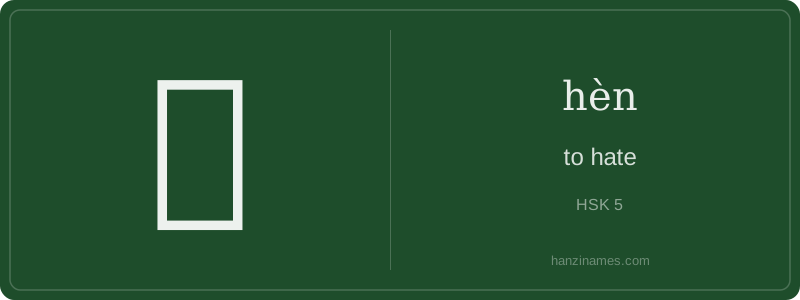
Historically, 恨 appears frequently in Tang and Song dynasty poetry and Ming-Qing novels to express sorrowful resentment—e.g., in Du Fu’s poems mourning war’s devastation or in Dream of the Red Chamber, where characters ‘恨’ lost love or unjust fate. In modern usage, it’s central to idioms like 恨之入骨 (‘hate to the bone’) and 恨铁不成钢 (a parent’s frustrated love for an underachieving child). Media and legal texts use it formally: ‘民愤极大’ (public hatred is extremely high) appears in court reports.
The character evolved from seal script, where 忄 (heart radical) + 艮 (gèn, meaning ‘to stop’ or ‘to restrain’) suggested ‘a heart held back by grievance’. While not a pictograph, this semantic-phonetic structure (heart + gèn sound) has been stable since the Han dynasty—documented in Shuōwén Jiězì (121 CE). No oracle-bone form exists; earliest attestation is in bronze inscriptions circa 5th century BCE with related roots.
Imagine a rainy afternoon in Chengdu, where a young teacher named Li Wei stands before her middle school class. She writes 恨 on the blackboard—not with anger, but with quiet intensity—as students read aloud lines from Lu Xun’s classic essay 'On the Collapse of the Leifeng Pagoda'. Here, 恨 isn’t just personal hatred; it’s moral indignation toward injustice, a layered emotion deeply embedded in modern Chinese literature and civic consciousness.
The character 恨 carries weight beyond simple dislike: it conveys profound, often righteous, resentment—felt toward oppression, betrayal, or loss. Unlike the English ‘hate’, which can be casual (‘I hate broccoli’), 恨 in standard Mandarin rarely appears in trivial contexts. It’s reserved for serious emotional stakes—broken trust, historical trauma, or deep sorrow masked as fury, like a mother grieving her child’s untimely death.
In spoken Chinese, 恨 is seldom used alone as a verb in daily speech (e.g., you won’t hear ‘我恨你’ casually among friends). Instead, it thrives in fixed expressions—like 恨不得 (‘can’t wait to’) or 恨铁不成钢 (‘to lament that good iron won’t become steel’)—where its emotional gravity transforms into poignant idiom. This duality—intense yet restrained, personal yet literary—makes it a hallmark of advanced fluency at HSK 5.
Example Sentences
Common Compounds
Similar Characters — Don't Mix These Up
Your First Step into Chinese Culture: Get a Chinese Name
Every journey into Chinese begins with a name. Use our free Chinese name generator to create a meaningful, personalized Chinese name that fits you perfectly.
Get My Chinese Name →