悠
Character Story & Explanation
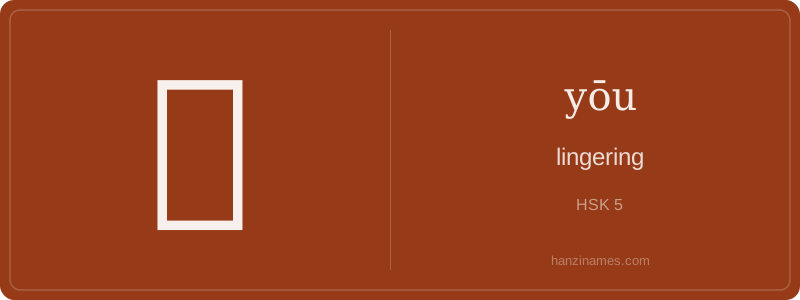
In modern Chinese, 悠 appears most frequently in literary, poetic, or reflective contexts—never in schedules or timestamps. It’s central to the idiom 悠然自得 (yōu rán zì dé), meaning 'serenely content', famously used by the Eastern Jin poet Tao Yuanming to describe his reclusive joy. The phrase 悠扬 (yōu yáng) describes music that is 'mellow and lingering', widely used in critiques of traditional guqin performances and documented in Ming dynasty music treatises.
The character’s form has no oracle-bone origin—it first appears reliably in Warring States bamboo texts. Structurally, it combines the heart radical (心) with 攸 (yōu), a phonetic-semantic component meaning 'far-reaching' or 'to extend'. Today, Chinese learners encounter it in HSK 5 reading passages about classical aesthetics or slow-living philosophies—not daily transactions, but moments where time feels textured and deep.
As an archaeologist brushing dust from a Han dynasty bamboo slip, I find 悠 inscribed in elegant clerical script—not as a mere descriptor of time, but as a psychological artifact. Its heart radical (心) anchors it in inner experience: not just 'long' in duration, but *felt* length—lingering resonance, unhurried awareness. This isn’t clock-time; it’s the stretched silence between temple bells, the breath held before a poem’s final line.
The upper component, 攸 (yōu), originally depicted a person holding a tool near water—suggesting measured, deliberate action. Paired with 心, it evolved into a semantic compound expressing sustained mental or emotional continuity. Early texts like the *Book of Songs* use 悠 to describe yearning that persists across seasons—proof that its core meaning emerged from embodied human temporality, not abstract measurement.
Unlike characters for linear time (e.g., 时), 悠 resists quantification. Its 11 strokes unfold deliberately: first the ‘heart’ foundation, then the graceful, looping strokes above—mirroring its semantic weight. In excavated Chu silk manuscripts, 悠 appears in meditative contexts, reinforcing its association with contemplative endurance. It is less a unit of time and more a *quality* of presence—one that ancient scribes carved not to count seconds, but to evoke depth.
Example Sentences
Common Compounds
Similar Characters — Don't Mix These Up
Your First Step into Chinese Culture: Get a Chinese Name
Every journey into Chinese begins with a name. Use our free Chinese name generator to create a meaningful, personalized Chinese name that fits you perfectly.
Get My Chinese Name →