果
Character Story & Explanation
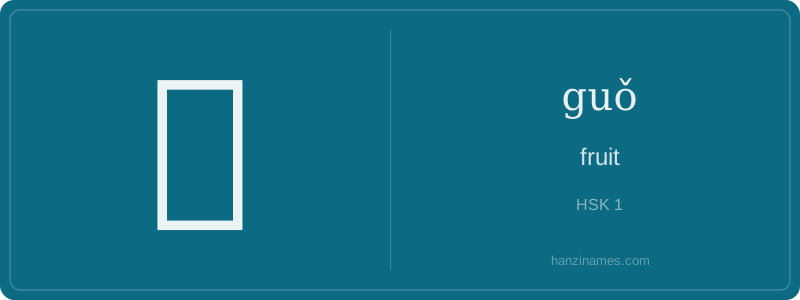
果 is ubiquitous in modern Chinese life: it appears on grocery labels (水果 shuǐguǒ), in idioms like 水到渠成,瓜熟蒂落 (‘When water flows, the channel forms; when melons ripen, stems detach’—emphasizing natural inevitability), and in formal terms like 成果 (chéngguǒ, ‘achievement’) used in education and policy reports. Historically, it was among the earliest characters standardized under Qin script (3rd c. BCE) and appears frequently in Han dynasty texts describing agriculture and governance.
Graphically, 果 is a pictograph-derived character: oracle bone and bronze inscriptions show a tree (木 mù) with prominent hanging fruits—later stylized into today’s form with the 木 radical at the bottom and the top element (田+丿) representing clustered fruits. Though simplified over millennia, its origin as a ‘tree bearing fruit’ remains visually legible and pedagogically emphasized in textbooks.
The Chinese character 果 (guǒ) literally means 'fruit'—the edible, seed-bearing product of a plant. Unlike English, where 'fruit' is primarily botanical and culinary, 果 carries layered meanings in Chinese: it also signifies 'result' or 'outcome' (e.g., 后果 hòuguǒ, 'consequence'), reflecting an ancient philosophical link between natural growth and human actions. This semantic duality echoes Confucian and Daoist ideas about cause-and-effect in nature and society.
In daily usage, 果 appears in both concrete and abstract contexts—ranging from supermarket signs (水果 shuǐguǒ, 'fresh fruit') to formal documents (成果 chéngguǒ, 'achievement'). Western equivalents like 'fruit' rarely extend so seamlessly into moral or logical domains; English uses separate words like 'result', 'effect', or 'consequence', whereas Chinese unifies them under one ideograph rooted in agricultural observation.
Culturally, 果 evokes abundance, reward, and natural order—similar to how apples symbolize knowledge in Western tradition, but with less mythic baggage and more pragmatic resonance. In festivals like Mid-Autumn, fruits like pomelos (柚子 yòuzi) and grapes are offered not just as food but as symbols of harmony and fulfillment—mirroring the character’s dual sense of bounty and outcome. This bridges botany, ethics, and language in a way few English words do.
Example Sentences
Common Compounds
Similar Characters — Don't Mix These Up
Your First Step into Chinese Culture: Get a Chinese Name
Every journey into Chinese begins with a name. Use our free Chinese name generator to create a meaningful, personalized Chinese name that fits you perfectly.
Get My Chinese Name →