校
Character Story & Explanation
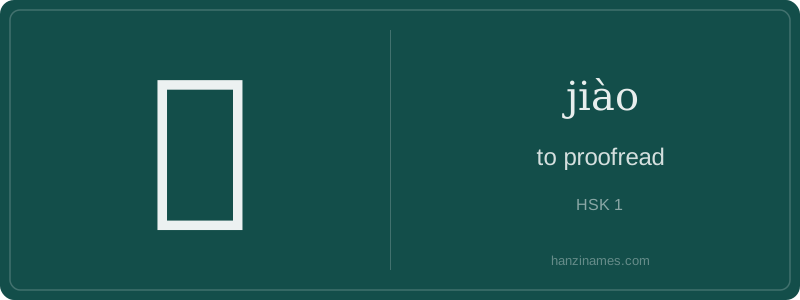
Historically, 校 (jiào) was central to Chinese textual scholarship: imperial scholars in the Han and Tang dynasties used it to collate and verify classical texts — comparing multiple manuscript copies to eliminate errors. Today, it remains essential in publishing, academia, and digital content creation. You’ll see it in terms like 校对 (jiàoduì, 'proofreading') and in editorial workflows — e.g., editors at People’s Daily or Commercial Press perform 校勘 (jiàokān, 'textual criticism'). It also appears in the idiom 一丝不苟 (yī sī bù gǒu), where 'not neglecting even a single thread' reflects the meticulousness embodied by 校.
The character combines 木 (wood) on the left and 交 (jiāo, 'to intersect/cross') on the right — documented since the Qin bamboo slips (c. 3rd century BCE) as a semantic-phonetic compound. The 木 radical signals its original association with wooden tally sticks used for verification; 交 provides both sound (ancient *kˤraw) and meaning — crossing or matching two items. No oracle bone form survives, but seal script inscriptions confirm this structure by 200 BCE.
Hello, learners! Today we’ll explore the character 校 (jiào), which means 'to check,' 'to collate,' or 'to proofread.' Though it’s an HSK Level 1 character, its pronunciation jiào is less common in daily speech than its homophone xiào (meaning 'school'). As a verb, 校 appears mostly in formal, academic, or publishing contexts — like editing texts, verifying data, or comparing versions of ancient manuscripts. Don’t confuse it with the noun form; context and tone tell you whether it’s 'proofreading' or 'school.'
Notice its radical: 木 (mù), meaning 'tree' — a clue to its ancient origin. Originally, wooden tally sticks were used for verification in early Chinese administration, and the act of matching them gave rise to the meaning 'to compare/check.' This historical link between wood and verification is preserved in the character’s structure, even though today’s usage is entirely abstract.
When reading aloud, always pay attention to tone: jiào is fourth tone (falling), not second (jiáo) or third (jiǎo). Mispronouncing it as xiào (also fourth tone, but different initial) would mean 'school' — a classic beginner mix-up! Practice saying jiào slowly: “jee-aw” (sharp drop). In writing, remember its 10 strokes — start with the wood radical on the left, then the right side ‘交’ (jiāo, 'to intersect') — symbolizing comparison or cross-checking.
Example Sentences
Common Compounds
Similar Characters — Don't Mix These Up
Your First Step into Chinese Culture: Get a Chinese Name
Every journey into Chinese begins with a name. Use our free Chinese name generator to create a meaningful, personalized Chinese name that fits you perfectly.
Get My Chinese Name →