桌
Character Story & Explanation
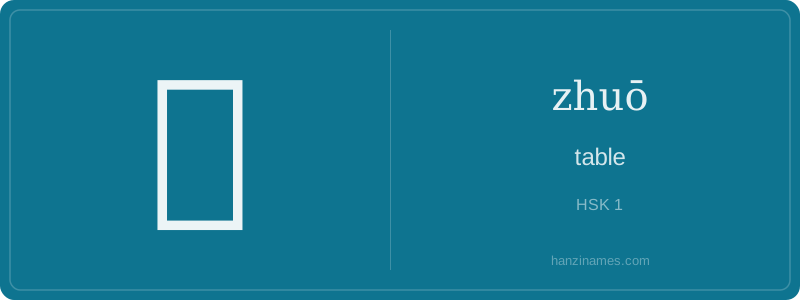
In modern China, 桌 appears everywhere: '餐桌' (cānzhuō, dining table), '课桌' (kèzhuō, student desk), and even digital contexts like '桌面' (zhuōmiàn, desktop). It’s central to common phrases such as '一桌菜' (yī zhuō cài, 'a full table of dishes')—a hallmark of hospitality—and the idiom '拍桌子' (pāi zhuōzi, 'to slam the table'), expressing anger or decisive action. Historically, wooden tables became widespread during the Ming dynasty, coinciding with the standardization of this character in printed texts.
The character is not pictographic but a later semantic-phonetic compound. Its earliest attested form appears in Song dynasty dictionaries; the 木 + 卓 structure was formalized to distinguish 'table' from homophones. No oracle bone or bronze script forms exist—it emerged as vernacular furniture culture matured, reflecting real-world usage rather than ancient symbolism.
The character 桌 (zhuō) is a foundational HSK Level 1 word meaning 'table'—a ubiquitous object in Chinese homes, classrooms, and offices. Its 10-stroke structure combines the 木 (mù, 'tree/wood') radical on the left with 卓 (zhuó, 'outstanding') on the right, reflecting its material origin and functional prominence. As one of the first nouns learners encounter, it appears constantly in daily instructions ('Put the book on the table'), making it essential for basic communication.
Visually, 桌 is a semantic-phonetic compound: 木 signals wood-based construction, while 卓 provides both sound (closely related to zhuō) and connotation—tables historically stood out as elevated, stable surfaces for work or ritual. This duality makes it memorable: not just furniture, but a cultural anchor for study, meals, and social gathering.
Unlike abstract characters, 桌 grounds language learning in tangible reality. Whether ordering tea at a Beijing hutong café or arranging desks in a Shanghai elementary classroom, learners immediately recognize and use it. Its consistent pronunciation (zhuō, first tone) and straightforward stroke order—beginning with the 木 radical—make it an ideal entry point into Chinese writing, building confidence before tackling more complex characters.
Example Sentences
Common Compounds
Similar Characters — Don't Mix These Up
Your First Step into Chinese Culture: Get a Chinese Name
Every journey into Chinese begins with a name. Use our free Chinese name generator to create a meaningful, personalized Chinese name that fits you perfectly.
Get My Chinese Name →