战
Character Story & Explanation
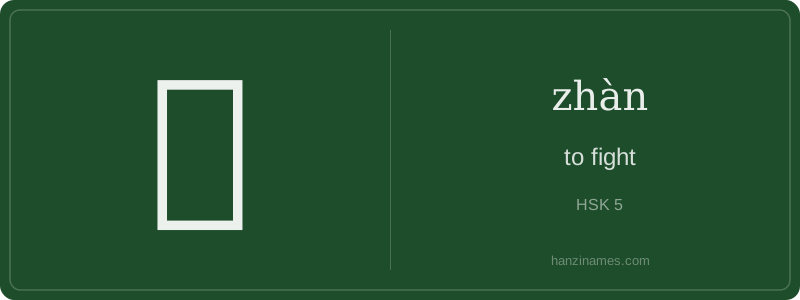
戰 (zhàn) appears in foundational texts like Sun Tzu’s Art of War and modern media like CCTV war documentaries. Common compounds include 战争 (zhànzhēng, 'war'), 战斗 (zhàndòu, 'combat'), and 战役 (zhànyì, 'campaign'). The idiom 短兵相接 (duǎnbīng xiāng jiē, 'short weapons meet')—referring to close-quarters combat—still appears in military training manuals. Historically, it was used in Tang legal codes to classify offenses: ‘临战脱逃’ (lín zhàn tuōtáo, 'desertion before battle') carried capital punishment.
The character’s form derives from seal script: left side 戈 (ge), a bronze halberd, is a clear pictograph of a weapon with blade and shaft; right side 占 evolved from a divination symbol (卜 + 口), later simplified. No oracle bone form of 战 survives—but its earliest attested use is on 4th-century BCE Chu bamboo slips, confirming its association with organized warfare, not mythic origins.
As an archaeologist brushing dust from a Warring States bamboo slip, I find 战 etched not as a mere verb but as a ritualized gesture—its 戈 (ge) radical, the bronze dagger-axe, anchors it in Bronze Age warfare. The right side, 占 (zhān), originally meant 'to divine' or 'to occupy', suggesting that ancient combat was inseparable from omens and territorial claim. This isn’t just 'fighting'—it’s sanctioned, strategic, cosmologically framed conflict.
Excavated inscriptions show 战 evolving from oracle-bone script variants where the ge component appeared independently in military records. By the Qin dynasty, standardized small seal script fused 戈 and 占 into a single character denoting organized hostilities—not skirmishes, but campaigns sanctioned by rulers and diviners alike. Its nine strokes encode hierarchy: the left-hand 戈 is drawn first, asserting martial primacy before the occupying/divining 占 follows.
Modern excavations at Liye Qin slips reveal 战 used in administrative documents—not just for battles, but for ‘military readiness’ and ‘defensive posture’. It carried bureaucratic weight: a county magistrate reporting ‘兵战已备’ (troops for battle are prepared) triggered logistical responses across commanderies. Thus, 战 never meant chaotic violence—it was disciplined, documented, state-managed action—making its HSK Level 5 placement apt: mastery requires grasping both lexical and institutional nuance.
Example Sentences
Common Compounds
Similar Characters — Don't Mix These Up
Your First Step into Chinese Culture: Get a Chinese Name
Every journey into Chinese begins with a name. Use our free Chinese name generator to create a meaningful, personalized Chinese name that fits you perfectly.
Get My Chinese Name →