抄
Character Story & Explanation
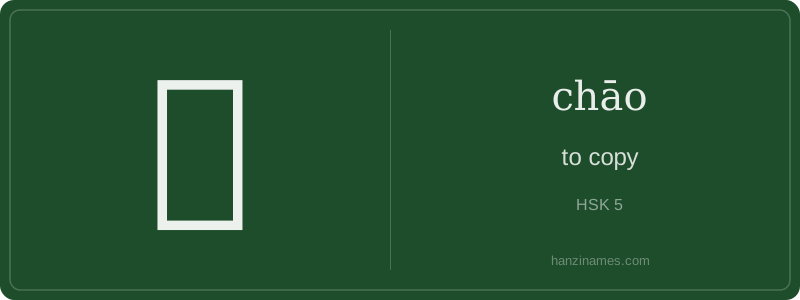
抄 is widely used in daily life: students 抄笔记 (chāo bǐjì, copy notes), journalists 抄送 (chāo sòng, CC in emails), and officials 抄家 (chāo jiā, confiscate property—historically during political campaigns like the Cultural Revolution, documented in official archives and memoirs). The phrase 抄袭 (chāoxí, plagiarism) appears in university academic regulations and copyright law enforcement reports since the 2001 Copyright Law revision.
The character’s form is phonosemantic: 扌 (hand radical) signals action involving the hand; the right component 少 (shǎo, ‘few’) serves primarily as a phonetic hint (though pronunciation diverged over time). No oracle-bone or bronze script form survives—its earliest attestation is in Han dynasty clerical script, consistently meaning ‘to transcribe’ or ‘to seize’.
The character 抄 (chāo) embodies a subtle tension in Chinese cultural values: reverence for tradition and authority coexists with pragmatic adaptation. To 'copy' is not merely mechanical reproduction—it’s an act of transmission, study, and sometimes quiet resistance. In classical education, students copied Confucian texts by hand to internalize wisdom; the physical act grounded learning in discipline and respect. This reflects a worldview where knowledge is not abstract but embodied—learned through repetition, gesture, and careful attention to form.
Yet 抄 also carries ethical weight. While copying calligraphy honors masters, copying exam answers violates integrity—a duality rooted in context, intent, and relationship. The hand radical (扌) foregrounds agency: it is *who* copies, *why*, and *how* that determines whether 抄 signifies diligence or dishonesty. This mirrors broader Chinese philosophical emphasis on relational ethics—meaning emerges from practice within social and moral frameworks, not isolated definitions.
In modern China, 抄 surfaces in digital life as both critique and creativity: internet users ‘copy’ memes to participate in collective humor, while educators warn against ‘copy-paste learning’. Even AI-generated text sparks debate over whether it’s 抄 (unoriginal replication) or 拓展 (expansion). Thus, 抄 is a cultural litmus test—revealing attitudes toward authorship, authenticity, and the evolving boundaries between imitation, inheritance, and innovation in a rapidly changing society.
Example Sentences
Common Compounds
Similar Characters — Don't Mix These Up
Your First Step into Chinese Culture: Get a Chinese Name
Every journey into Chinese begins with a name. Use our free Chinese name generator to create a meaningful, personalized Chinese name that fits you perfectly.
Get My Chinese Name →