括
Character Story & Explanation
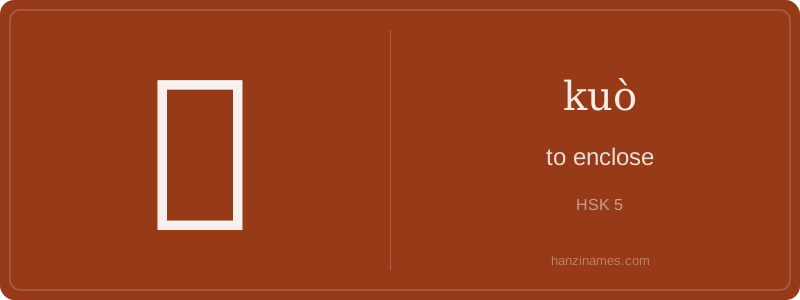
括 is widely used in modern Chinese for grammatical and logical enclosure—most notably in 括号 (kuòhào, 'parentheses'), a term standardized in early 20th-century language reforms and now ubiquitous in textbooks, coding, and official documents. It also appears in the HSK-5 idiom 概括起来 (gàikuò qǐlái, 'in summary'), reflecting its role in academic and bureaucratic discourse. Historically, 括 appears in Song-dynasty texts like the *Yingzao Fashi* (1103 CE), where it described tightening joints in timber framing—confirming its original meaning of physical constriction.
The character is not pictographic but phono-semantic: 扌 (hand radical) denotes action; 曷 (hé) provides approximate pronunciation. No oracle-bone or bronze inscriptions of 括 survive, but its earliest verified form appears in Han-era clerical script, already with the hand+曷 structure. Today, Chinese students first encounter it in middle-school grammar lessons on punctuation—and instantly recognize it from the parentheses icon ( ) on keyboards and exams.
The Chinese character 括 (kuò) originally conveyed the physical action of binding or tightening—like drawing a rope taut around an object. Its left-hand radical 扌 (hand) signals manual action, while the right component 曷 (hé) serves phonetically. Though modern usage has broadened, this core idea of ‘constraining’ or ‘enclosing’ persists in both literal and abstract contexts—from tightening a knot to enclosing text in parentheses.
In contemporary Mandarin, 括 most commonly appears in grammatical and technical terms, especially as part of compound words like 括号 (kuòhào, 'parentheses') or 概括 (gàikuò, 'to summarize'). Unlike English verbs such as 'tie' or 'bind', which emphasize physical force, 括 leans toward conceptual containment: wrapping ideas, data, or scope within defined limits—reflecting a linguistic preference for systemic order over brute action.
Western equivalents like 'bracket', 'enclose', or 'summarize' capture aspects of 括 but miss its tactile origin. In English, 'to bracket' is purely functional (e.g., math or syntax), while 'to tie up' implies finality or restriction. 括 bridges both: it’s neither purely mechanical nor purely rhetorical—it’s the disciplined act of demarcation itself. This duality mirrors Confucian values of measured expression and structural clarity, where boundaries enable understanding rather than suppress it.
Example Sentences
Common Compounds
Similar Characters — Don't Mix These Up
Your First Step into Chinese Culture: Get a Chinese Name
Every journey into Chinese begins with a name. Use our free Chinese name generator to create a meaningful, personalized Chinese name that fits you perfectly.
Get My Chinese Name →