措
Character Story & Explanation
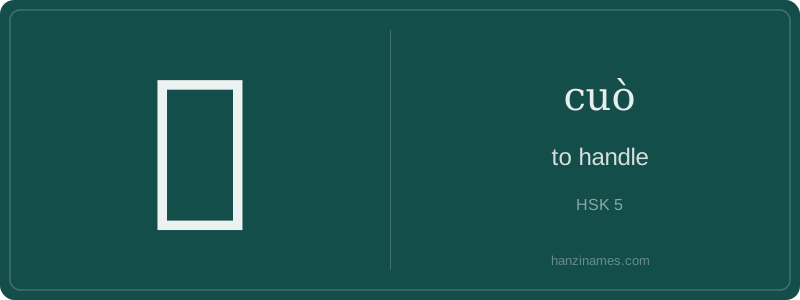
In modern Chinese, 措 is rarely used alone but appears frequently in formal, written, and bureaucratic language—especially in compound words related to policy, crisis management, and legal implementation. It features in official documents, news headlines (e.g., 应急措施, 'emergency measures'), and HSK-5 level reading passages. A well-documented idiom is 举措得当 (jǔ cuò dé dàng), meaning 'measures taken appropriately,' often cited in government white papers and media analysis of policy effectiveness.
The character is not pictographic nor attested in oracle bone script. Its earliest confirmed form appears in Warring States bamboo slips as a phono-semantic compound: 扌 (hand radical, indicating action) + 昔 (phonetic component, approximating cuò). No ancient pictorial origin exists—its power lies in semantic precision, not visual symbolism.
Our detective begins at the crime scene: the character 措. First, we note its left-hand radical 扌—'hand'—a clear clue that this character involves physical or deliberate human action. The right side, 昔, originally depicted a sun (日) over dried meat (肙), later evolving to mean 'past' or 'former times.' But here, 昔 functions phonetically, hinting at pronunciation (cuò), not meaning—a classic example of a phono-semantic compound.
Zooming in on historical records, 措 appears in early classical texts like the *Zuo Zhuan* (c. 4th century BCE), always paired with verbs of agency: 'to place,' 'to implement,' or 'to handle matters.' It never stands alone as a simple verb—it requires an object and context, revealing its grammatical nature as a transitive, deliberative action. This isn’t impulsive doing; it’s measured, responsible handling.
The detective’s final insight? 措 carries quiet moral weight. In Confucian administrative writing, 措事 (cuò shì) meant 'handling affairs with integrity,' implying ethical judgment—not just capability. Even today, its use in formal contexts (e.g., 政策措置) signals intentionality and accountability. Unlike casual synonyms like 做 (do), 措 implies thoughtful deployment of resources, authority, or strategy—making it indispensable in governance, law, and crisis response.
Example Sentences
Common Compounds
Similar Characters — Don't Mix These Up
Your First Step into Chinese Culture: Get a Chinese Name
Every journey into Chinese begins with a name. Use our free Chinese name generator to create a meaningful, personalized Chinese name that fits you perfectly.
Get My Chinese Name →